


Movie Poster Sizes in Australia: Daybills, One-Sheets and Frame Fit

The most common movie poster sizes in Australia are the daybill, at about 13 × 30 inches (33 × 76 cm), and the one-sheet, at 27 × 40 inches (68.6 × 101.6 cm). Older one-sheets often measure 27 × 41 inches. All sizes here are width × height, and the right frame depends on your poster’s real measurements.
Please note: the sizes below are nominal, meaning they’re the standard sizes each format was meant to be. Real posters, especially older ones, often vary by a few millimetres or more, so always measure yours before ordering a frame.
Movie poster sizes in Australia: quick reference
Australian cinemas mainly used two formats: the tall, narrow daybill and the larger one-sheet. Retail posters and modern reprints add a few more sizes.
| Format | Inches (w × h) | Centimetres (w × h) | Rough era |
| Long daybill | About 15 × 40 | About 38 × 101.6 | 1920s to early 1940s |
| Wartime daybill | About 10 × 30 | About 25.4 × 76.2 | Around 1942–45 |
| Standard daybill | 13 × 30 | 33 × 76.2 | Early 1940s to early 1980s |
| Shorter daybill | About 13 × 26 | About 33 × 66 | From around the 1980s |
| Older one-sheet | 27 × 41 | 68.6 × 104.1 | Before about 1985 |
| One-sheet | 27 × 40 | 68.6 × 101.6 | From about 1985 |
| Retail poster | 24 × 36 | 61 × 91.4 | Modern shop posters |
| A1 print | 23.4 × 33.1 | 59.4 × 84.1 | Modern prints and reprints |
What sizes are Australian daybills?
Most Australian daybills measure about 13 × 30 inches (33 × 76 cm), but the format changed size several times.
The National Film and Sound Archive of Australia describes the daybill as a uniquely Australian format measuring 13 × 30 inches. It also notes that daybills were printed using stone lithography, giving them a lighter, sketchier look than offset-printed posters.
Australian daybill sizes from the 1920s to the 1980s
Before World War II, the “long” daybill was closer to 15 × 40 inches. During the war, paper shortages pushed daybills down to about 13 × 30 inches, and some shrank as far as 10 × 30. The 13 × 30 size then stayed standard until many daybills shrank to roughly 13 × 26 inches from around the 1980s.
Real daybill dimensions vs the 13 × 30 inch standard
Many daybills don’t measure exactly 13 × 30 inches. They’re commonly listed at 13¼ × 30 or 13½ × 30 inches, and that extra half inch (about 1.3 cm) matters when you’re working out a daybill frame size. A few were even printed in landscape format, so don’t assume yours is a portrait poster.
One-sheet sizes: 27 × 40 vs 27 × 41 inches
A modern one-sheet measures 27 × 40 inches (68.6 × 101.6 cm), while many older one-sheets measure 27 × 41 inches (68.6 × 104.1 cm).
Australian one-sheets moved to the 27 × 40 size around 1985. Earlier posters were usually a little longer and were sent to cinemas folded, while later ones were mostly rolled.
The width is the same, so the extra inch is easy to miss, but it adds about 2.5 cm to the height. A frame made for a 27 × 40 poster can’t hold a 27 × 41 sheet without covering, bending or cutting part of it.
Cinema posters vs retail posters: what is the difference?
Cinema posters were made for theatres, while retail posters are printed to sell in shops, and the two usually come in different sizes.
A common retail size is 24 × 36 inches (61 × 91.4 cm), and many reprints are sold in A1, which is 59.4 × 84.1 cm. A 24 × 36 poster is 3 inches narrower and 4 inches shorter than a cinema one-sheet. A1 is closer to 24 × 36, but it’s still about 1.6 cm narrower and 7.3 cm shorter.
Will your movie poster fit an A1 or 70 × 100 cm frame?
An original one-sheet won’t fit an A1 frame, and a 27 × 40 one-sheet is also slightly too long for a 70 × 100 cm frame.
An A1 frame suits paper measuring 59.4 × 84.1 cm, which is smaller than a one-sheet in both directions. With a 70 × 100 cm frame, the width works because 68.6 cm is under 70 cm, so only the height causes trouble. Here’s how common posters compare:
| Poster | A1 frame (59.4 × 84.1 cm) | 70 × 100 cm frame | 27 × 40 in frame |
| One-sheet (27 × 40) | Frame too small | Frame about 1.6 cm too short | Fits |
| Older one-sheet (27 × 41) | Frame too small | Frame about 4 cm too short | Frame about 2.5 cm too short |
| Retail poster (24 × 36) | Frame too small | Fits with gaps; needs a mat | Fits with gaps; needs a mat |
| Daybill (13 × 30) | Fits with wide gaps; needs a mat | Fits with wide gaps; needs a mat | Fits with wide gaps; needs a mat |
A movie poster frame size normally describes the opening the paper sits in, as our picture frame size guide explains. Some products list outside dimensions instead, so check before you buy.
How should you measure a movie poster for framing?
Measure the whole sheet of paper from edge to edge, width first and then height, with the poster lying flat. Record the movie poster size in cm and inches, because frames are sold in both.
Paper size, artwork, mat opening and frame size explained
Framers work with four measurements, and they’re not interchangeable:
- Full paper sheet: the entire piece of paper, including printed borders and margins.
- Printed artwork: just the image area.
- Mat opening: the window cut in the mat. It’s usually slightly smaller than what you want to show, so the mat overlaps the edges.
- Outside frame size: the finished size on the wall. It’s useful for planning space, but not for checking fit.
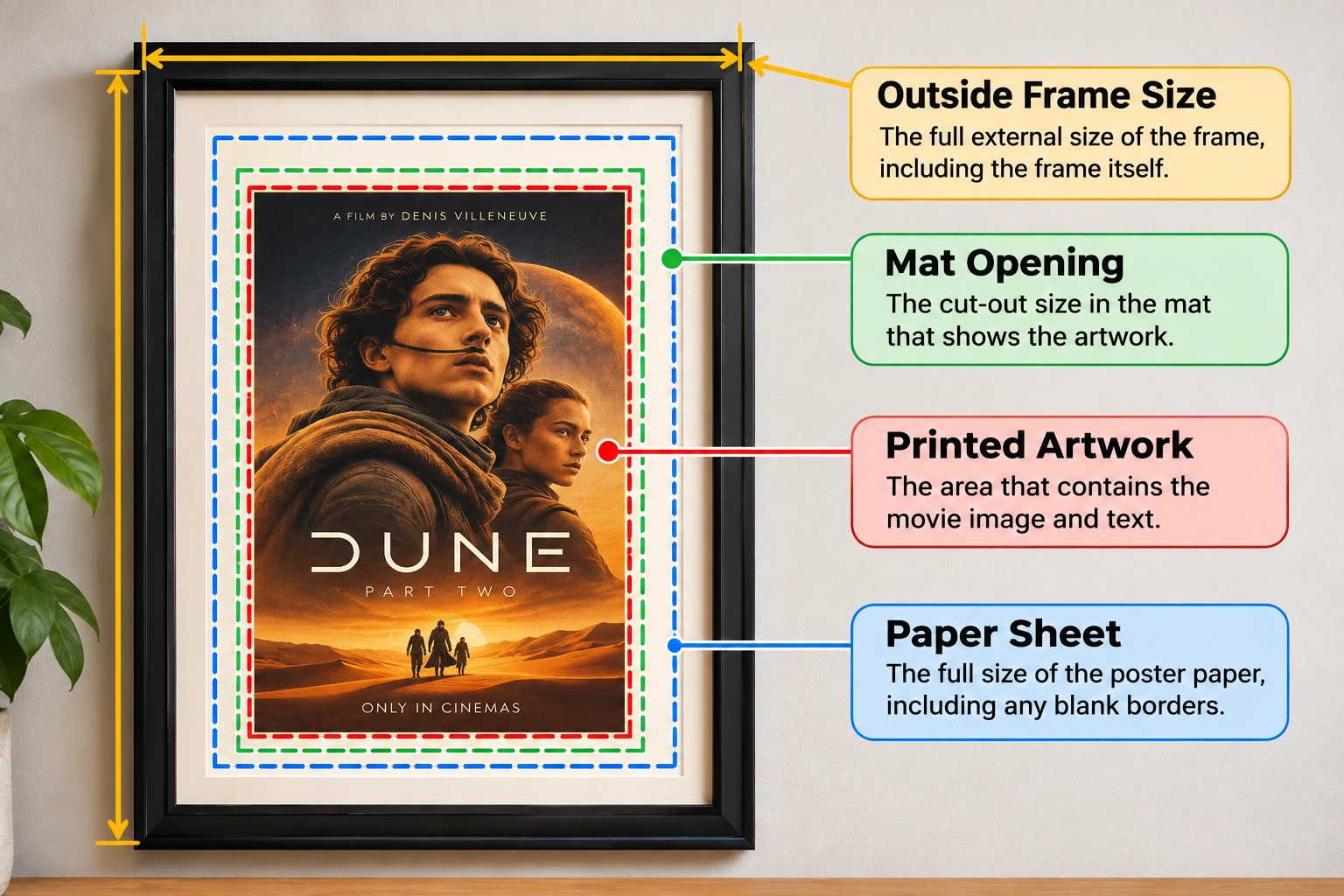
Measure each side at both ends, because older paper isn’t always square. Always include printed borders, which often carry credits that belong to the original design.
Measuring folded and linen-backed movie posters
Folded and linen-backed posters need gentle handling and an overall measurement. Older daybills and one-sheets usually have fold lines, so don’t press hard to get a flatter reading. The National Archives of Australia includes prints and posters in its paper-preservation advice and warns that poor handling causes damage. Handle older posters as little as possible.
A linen-backed poster is one mounted onto fabric for support. Record the size of the whole piece, then ask your framer how the backing and edges should be displayed. Framous Picture Framing’s guide to framing vintage movie memorabilia covers preservation choices for valuable originals and unusual borders.
Once you’ve confirmed the dimensions, read our guide on how to frame a movie poster for help with materials and mounting.
When should you choose a custom frame?
Choose a custom frame when your poster’s measurements don’t match a frame you can buy, or when the poster is too valuable to risk a poor fit.
That usually applies to:
- older 27 × 41 one-sheets
- daybills in non-standard sizes
- linen-backed posters with wide borders
- any original you don’t want trimmed or squeezed
You won’t always need a fully custom frame. A daybill or retail poster can sometimes go into a standard frame with a custom-cut mat, as long as the frame’s outer size suits your wall. If your poster’s measurements differ from available frame sizes, custom picture framing can accommodate the actual sheet.
Framous Picture Framing frames prints and posters at its Midland, Perth shop, and also lists restoration of artwork and photography among its services. Our comparison of custom framing and ready-made frames explains the trade-offs. Our guide to how much custom framing costs in Perth can help you budget.
Why does your poster’s format matter before framing?
Your poster’s format tells you which problems to expect before you pay for a frame that won’t work.
Movie poster sizes in Australia have shifted over the decades, so a format name is a starting point rather than a measurement.
Even so, knowing you have an older one-sheet or a daybill warns you early about extra length or the need for a mat.
Frame your movie poster with Framous Picture Framing
At Framous Picture Framing, we believe a treasured poster deserves a frame that fits properly and suits the room it hangs in. The easiest way to start is with the poster itself. Bring it into our Midland shop or call (08) 9274 1453 to talk through its format, measurements and how you’d like it displayed.
From there, our qualified colour theorist and character assessor can help you choose mouldings, mats and a style that suit the poster and your budget. Prefer to leave it to us? We’ve been designing frames in Midland since 1985, and we’re open Tuesday to Saturday, with Monday visits by appointment.
Whether it’s a folded vintage daybill, an older 27 × 41 one-sheet or a favourite retail print, explore our picture framing services and let’s give your poster the frame it deserves.
Frequently asked questions
What size were Australian daybills in the 1990s?
Some late daybills were smaller again. Collector references describe 1990s “mini” daybills of roughly 34–35 cm by 50–55 cm, often folded once or not at all. Production appears to have ended by the mid-1990s.
What size is an Australian lobby card?
Lobby cards usually measure 11 × 14 inches (about 28 × 36 cm). That’s one of the standard sizes in our photo print size guide, so a ready-made frame often works, but measure the card first.
Is an Australian one-sheet the same as a US one-sheet?
They share the same sizes but not always the same design. The National Film and Sound Archive notes that Australian posters were often modified from their American or UK versions, sometimes to highlight local talent in the film.

Leave a Reply