

Standard Photo Print Sizes for Frames: The Complete Guide
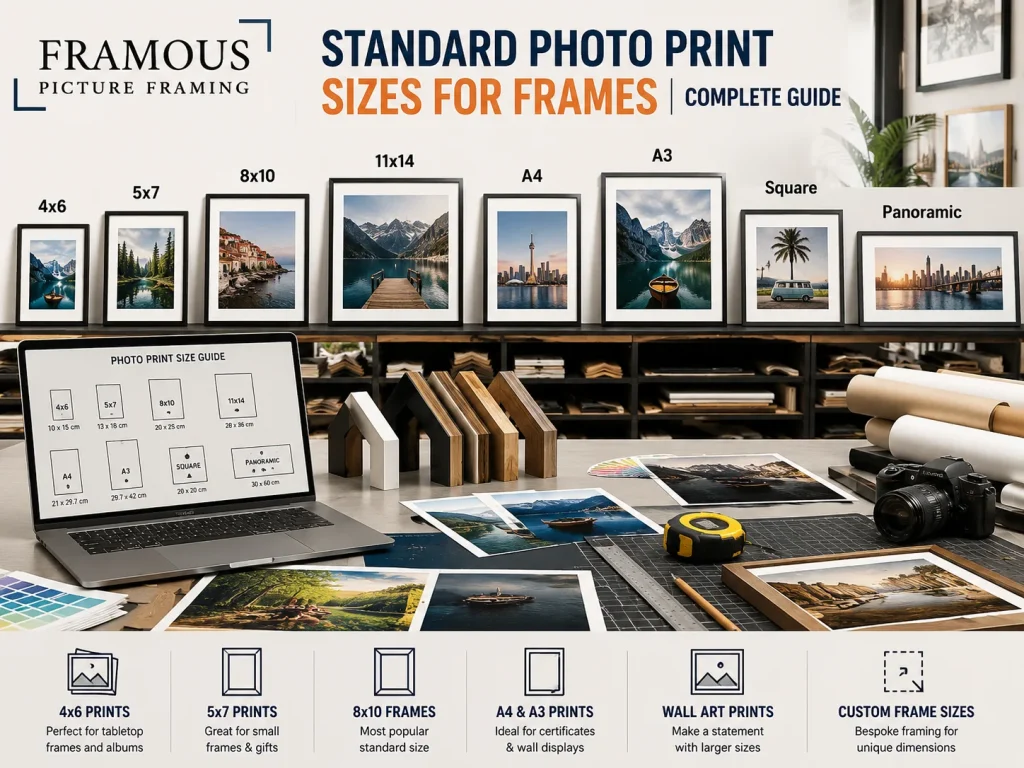
Choosing the right standard photo print size for a frame can make all the difference to how your finished display looks. Whether you’re framing family photos, wedding portraits, holiday memories, or professional photography, selecting the correct print size helps ensure the image fits properly and looks its best.
In this article, we’ll go over the most common photo sizes, how they relate to standard frame sizes, and the key factors to consider before printing your photos.
Standard Photo Print Sizes for Frames: Quick Answer
In Australia, standard photo frame dimensions are 4×6, 5×7, 6×8, 8×10, 8×12, 11×14, 12×18, 16×20, and 20×30 inches.
Here’s a quick guide to their most common uses:
- 4×6 inches: Holiday snaps, photo albums, everyday recollections.
- 5×7 inches: Family pictures, gifts and tabletop displays.
- 8×10 inches: Portraits, corporate displays & professional photography.
- 11×14 inches: Wedding photos, artwork, and feature pieces.
- 16×20 inches and larger: Gallery walls, large home decor, statement prints.
Standard Photo Print Sizes for Frames
| Photo Print Size (inches) | Approx. Size (cm) | Standard Frame Size | Best For |
| 4 × 6 | 10 × 15 cm | 4 × 6 frame | Photo albums, travel photos, everyday memories |
| 5 × 7 | 13 × 18 cm | 5 × 7 frame | Gifts, bedside tables, family portraits |
| 6 × 8 | 15 × 20 cm | 6 × 8 frame | Portraits and small wall displays |
| 8 × 10 | 20 × 25 cm | 8 × 10 frame | Family portraits, certificates, office displays |
| 8 × 12 | 20 × 30 cm | 8 × 12 frame | Landscape photography and modern décor |
| 11 × 14 | 28 × 36 cm | 11 × 14 frame | Wedding photos, artwork, feature displays |
| 12 × 18 | 30 × 45 cm | 12 × 18 frame | Panoramic photography and medium wall art |
| 16 × 20 | 40 × 50 cm | 16 × 20 frame | Gallery walls and statement pieces |
| 20 × 30 | 50 × 76 cm | 20 × 30 frame | Large-format photography and feature walls |
Remember, these sizes will work for most framing projects, but your choice will depend on where you are going to display your photo and the type of image you are printing.
How to Choose the Right Photo Print Size
The ideal choice depends on the space you have, the subject matter of the photograph and how you want it displayed.
The 4×6-inch print remains the most convenient for picture albums and ordinary photographs. It is tiny, inexpensive and fits in most conventional photo albums.
If you’re putting images on a desk, shelf or bedside table, 5×7 and 6×8-inch prints offer a broader viewing area without dominating the space. They are popular alternatives for family pictures and thoughtful gifts.
Wall displays benefit from larger print sizes as they have more visual impact. For portraits, an 8×10-inch print is the perfect size; for wedding photos or artwork, 11×14 is a more stunning display. If you are making a feature wall or gallery-style display, 16 x 20 inches or larger makes the image a true focal point.
Professional Tip: One bit of advice we typically give customers is to think about viewing distance when picking a print size. A photo that looks beautiful on a bedside table might be too small on a vast living room wall. When the print size is adjusted to fit the available space, the display is more balanced and visually pleasing.
Print Size vs Frame Size: Understand the Difference
One of the biggest misconceptions we encounter in our framing studio is the difference between a photo print size and a frame size. Most consumers assume these are distinct sizes, but often the size of the frame is the size of the photo it is designed to accommodate, not the outside dimensions of the frame.
For example, an 8 x 10 frame is made to hold an 8 by 10 inch photo. The total frame is of course, larger due to its border, but the opening is sized expressly for an 8 × 10 print.
Understanding this simple distinction can save you from ordering the wrong print or purchasing a frame that doesn’t fit your photo.
When Should You Use a Larger Frame?
We recommend using a larger frame with a mat board for photographs that deserve extra attention. It frames the picture, giving additional visual room around the image and pulling the viewer’s eye toward the photograph itself.
It’s a framing style we frequently use for:
- Wedding and family portraits
- Original artwork and fine art prints
- Certificates and awards
- Military medals and memorabilia
- Sporting jerseys and collectibles
Besides improving presentation, a quality mat board also helps keep the artwork away from the glass, reducing the risk of moisture damage and helping preserve treasured pieces over time. Here’s how standard print and frame sizes typically work together.
| Photo Print Size | Frame Size | Mat Board Required? |
| 4 × 6 | 4 × 6 | No |
| 5 × 7 | 5 × 7 | No |
| 8 × 10 | 8 × 10 | No |
| 8 × 10 | 11 × 14 | Yes |
| 11 × 14 | 16 × 20 | Yes |
Expert Tip: If you’re replacing an existing photo, measure the visible opening or the current print, rather than the outside dimensions of the frame. This simple step helps ensure your replacement print fits perfectly.
Understand Photo Aspect Ratios
We also often help consumers who have accidentally cropped their photos. Someone orders a print, puts it in the frame and sees that crucial elements of the image have disappeared or that white borders have developed around the corners.
Almost always, the cause is the aspect ratio.
An aspect ratio describes the relationship between a photo’s width and height. Different cameras, smartphones, and editing software produce images in different proportions, which is why not every photo fits every standard print size.
The most common aspect ratios include:
| Aspect Ratio | Common Source | Compatible Print Sizes |
| 3:2 | DSLR and mirrorless cameras | 4×6, 8×12, 12×18, 20×30 |
| 4:3 | Most smartphones and compact cameras | 6×8, 9×12 (or slight cropping for other sizes) |
| 5:4 | Traditional portrait photography | 8×10, 16×20 |
| 1:1 | Square social media images | Square prints and frames |
| 16:9 | Panoramic photography | Panoramic or custom-sized frames |
The Importance of Aspect Ratios
If you size your print to the aspect ratio of your photo, you will not lose any part of the image to cropping or stretching.
For example, many DSLR and mirrorless cameras capture images using a 3:2 aspect ratio, making 4×6, 8×12, and 12×18 excellent choices because they retain the original composition.
An 8×10 print, however, has a 5:4 aspect ratio. Printing a 3:2 image at this size usually means a small amount of the photo needs to be cropped.
Similarly, many smartphones save photographs in a 4:3 aspect ratio. These photographs will still print at 4×6 but may be cropped somewhat or have thin white borders depending on the printer settings.
Photo Print Size Conversion Chart
Photo print sizes are generally listed in inches, but many Australian vendors also list approximate metric measurements. Knowing them both helps you compare products and pick appropriate frames. So let’s have a look:
| Print Size (Inches) | Approx. Size (Centimetres) | Size (Millimetres) |
| 4 × 6 | 10 × 15 cm | 102 × 152 mm |
| 5 × 7 | 13 × 18 cm | 127 × 178 mm |
| 6 × 8 | 15 × 20 cm | 152 × 203 mm |
| 8 × 10 | 20 × 25 cm | 203 × 254 mm |
| 8 × 12 | 20 × 30 cm | 203 × 305 mm |
| 11 × 14 | 28 × 36 cm | 279 × 356 mm |
| 12 × 18 | 30 × 45 cm | 305 × 457 mm |
| 16 × 20 | 40 × 50 cm | 406 × 508 mm |
| 20 × 30 | 50 × 76 cm | 508 × 762 mm |
Common Mistakes to Avoid While Choosing Photo Print Sizes and Frames
After framing photographs, artwork, and memorabilia for decades, we’ve noticed that the same mistakes come up time and time again. The good news is that they’re easy to avoid with a little planning before you print.
Assuming the Frame Size Is the Outside Measurement
One of the most common misunderstandings is believing that the listed frame size refers to its outer dimensions. In most cases, it actually refers to the size of the photo the frame is designed to hold.
For example, an 8 × 10 frame is designed for an 8 × 10-inch print, even though the frame itself is larger because of its border.
Overlooking the Photo’s Aspect Ratio
Not all images will fit all print sizes. If you select a print size with a different aspect ratio, there may be chopped corners or undesired white borders.
View your photo printing service preview before you purchase prints. It is a simple procedure that can save the original composition of your photograph.
Skipping the Mat Board
Many people think of mat boards as solely decorative, but they also serve a utilitarian role.
In our shop, we commonly suggest mat boards for photos, artwork and certificates, as they give visual balance, assist in separating the print from the glass and give a more refined look to the finished piece. They work well, especially when utilising a bigger frame with small print.
Printing Images That Are Too Low in Resolution
This is especially true for images downloaded from social media or received in messaging apps. If an image is compressed, it may look crisp on a phone or computer screen, but it will lack the detail needed for larger prints.
Whenever printing at 11×14 inches or greater, always utilise the original image from your camera or smartphone if available. The greater resolution produces a much crisper and more detailed image.
Measuring the Wrong Part of the Frame
Do not measure the outside of the frame if substituting an existing photo. Use the inside opening or the print you have, not the outside. This quick check ensures that your new photo fits right, without any trimming or other edits.
Protect and Showcase Your Memories with Framous Picture Framing
Choosing the right print size is just the beginning. The perfect frame brings your photo to life while protecting it for years to come.
At Framous Picture Framing, we’ve been creating custom frames in Perth for over 40 years. You can get the following framed by us:
- Family photos and wedding portraits
- Artwork and limited-edition prints
- Certificates and awards
- Treasured keepsakes and memorabilia
If you are still unsure which frame size, mat board, or design is right for your photo. Visit our showroom in Midland and let our experienced team guide you through the options.
See Our Completed Framing Projects
FAQs
What is the most common standard photo print size for frames?
The 4 x 6-inch print is the most popular regular photo size. It fits easily into 4 x 6 frames, it has the same aspect ratio as many digital cameras, and it’s great for picture albums, travel photos and ordinary family memories.
Is an 8 × 10 photo the same size as A4?
No. An 8 × 10-inch photo measures approximately 203 × 254 mm, while A4 paper measures 210 × 297 mm. An A4 frame is not an immediate replacement for an 8 x 10 photo because of different dimensions and aspect ratios, unless you use a mat board or change the print.
What is the largest standard photo print size?
For ready-made frames, 20 × 30 inches is one of the largest standard photo print sizes. It’s a popular choice for feature walls, landscape photography, and large-format artwork. If you need a larger display, custom printing and framing are also available.
Can I use a larger frame for a smaller photo?
Yes, one popular framing approach is to use a wider frame with a mat board to give a clean, gallery-style presentation. It’s a method we often recommend for family portraits, wedding photos, certifications and fine art since it adds to the visual impact and helps maintain the print over time.
