

How to Display Your War Medals in a Photo Frame
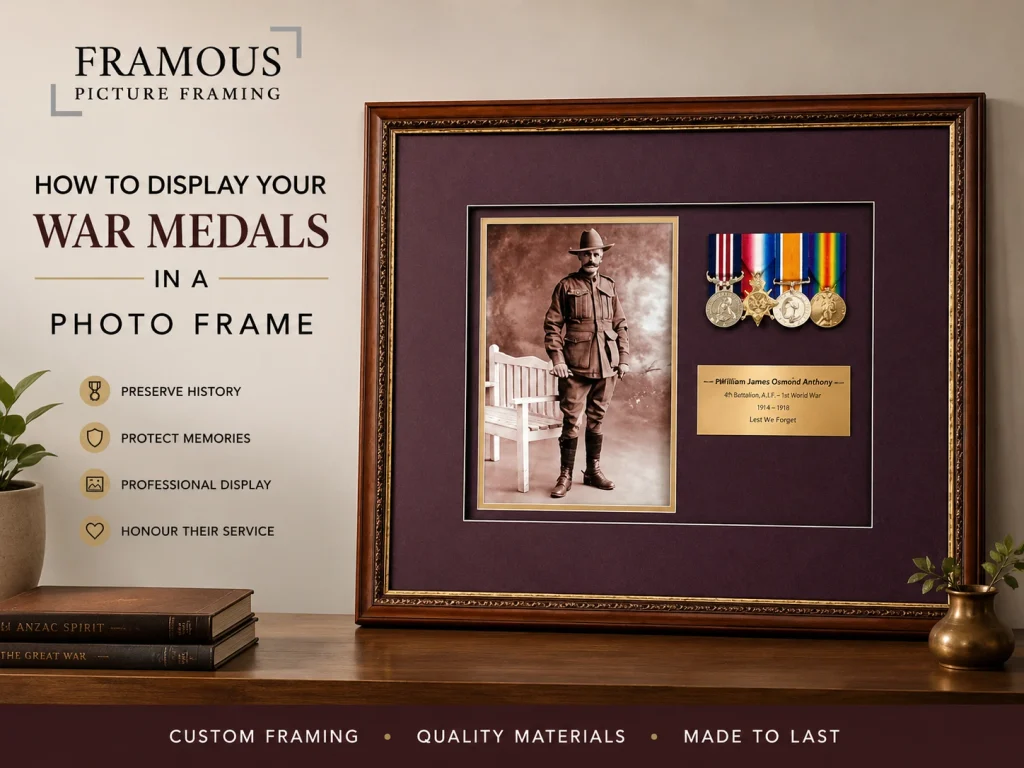
War medals can be displayed in several ways, and the right approach depends on how they’re mounted, whether they belong to a group, and whether you want to include photos or other memorabilia alongside them. A loose medal on a ribbon needs different handling to a court-mounted group, and a single Anzac medal sits very differently in a frame than a full set with clasps and bars.
This guide walks through the main medal and photo frame formats you’ll come across, how each one is framed properly, and what to think about if you’re arranging more than one medal together.
Australian Military Medals and How to Frame Them
Not every medal sits in a frame the same way. Before you buy a frame or book in with a medal framer, it helps to know which of these six forms you’re actually working with.
Loose Hanging Medals
Loose hanging medals are the ones still attached only by a plain ribbon, with nothing sewn or pinned to hold them flat. They swing freely, which is exactly the problem when it comes to framing them.
How to Frame:
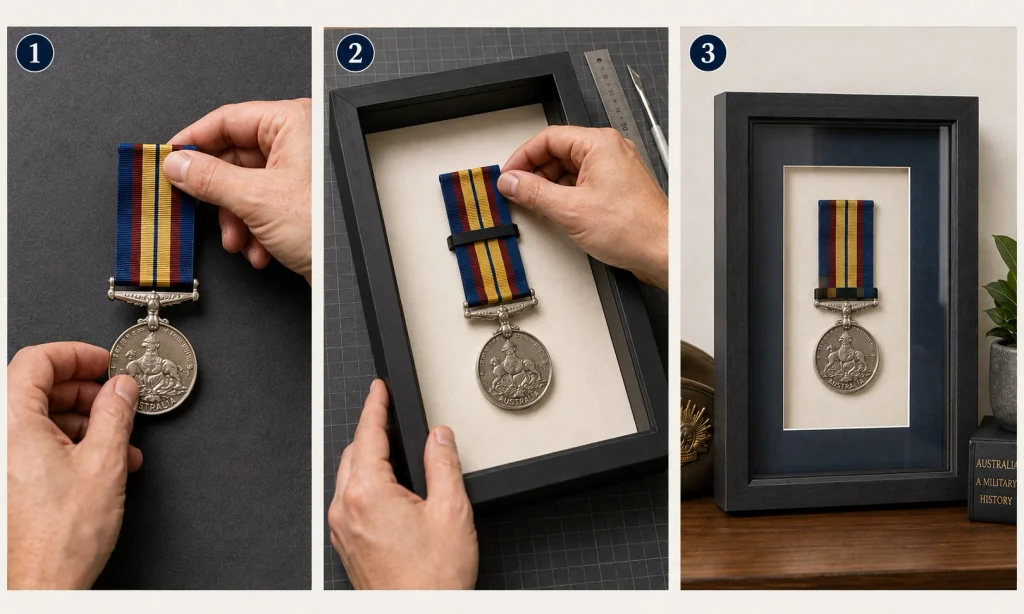
- Use a deep box frame, at least 35–40mm in depth, so the medal doesn’t press against the glass.
- Pin or lightly stitch the ribbon to an acid-free backing board rather than gluing it. Glue degrades ribbon fibres over time.
- Position the medal slightly off-centre if you’re adding a photo, so the eye naturally moves between the two.
- Leave a small gap behind the medal face using foam spacers, so any embossing or relief detail isn’t crushed flat against the mount.
The most common mistake here is using a standard flat frame. Loose medals need depth, or they’ll sit crooked and eventually mark the glass.
Ribbon-Mounted Medals
These medals have their original ribbon still attached and intact, but no additional mounting hardware. The ribbon itself is part of the display, so it needs to stay visible and uncreased.
How to Frame:
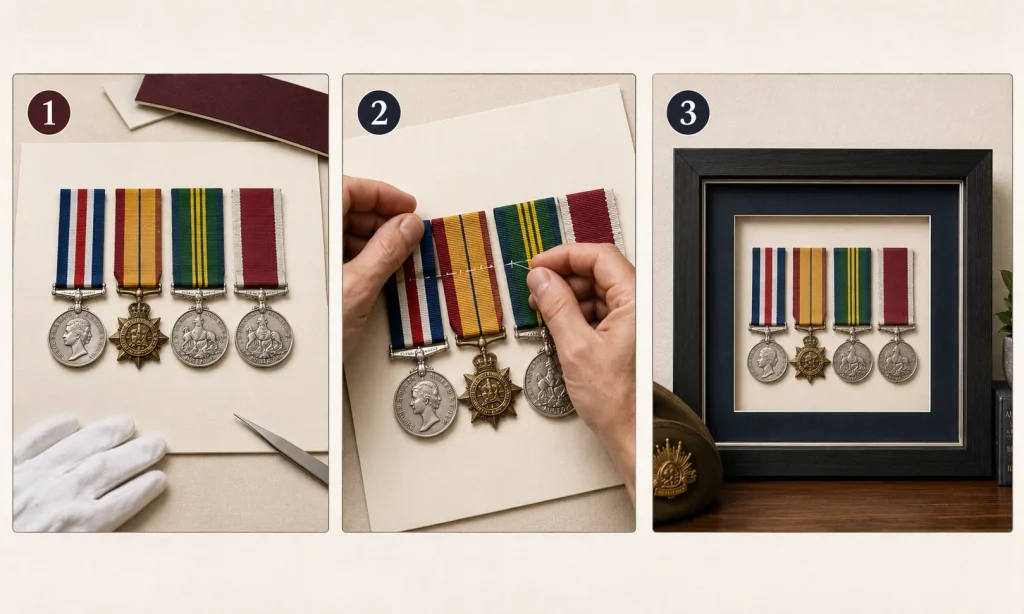
- Lay the ribbon flat rather than folded, and secure it at two points along its length using small fabric-safe stitches through the backing.
- Choose a mat board colour that doesn’t compete with the ribbon’s stripes. Navy, burgundy or charcoal mats usually work better than bright whites.
- Keep at least 15mm of clear space around the medal edge so it doesn’t look cramped inside the opening.
If the ribbon has faded or frayed, this is worth mentioning to your framer before mounting. It’s much easier to stabilise ribbon damage before it goes behind glass than after.
Brooch-Mounted Medal Groups
A brooch bar joins several medals together so they can be worn in one continuous row. This is common with WWI and WWII service groups and generally needs more room than people expect.
How to Frame:
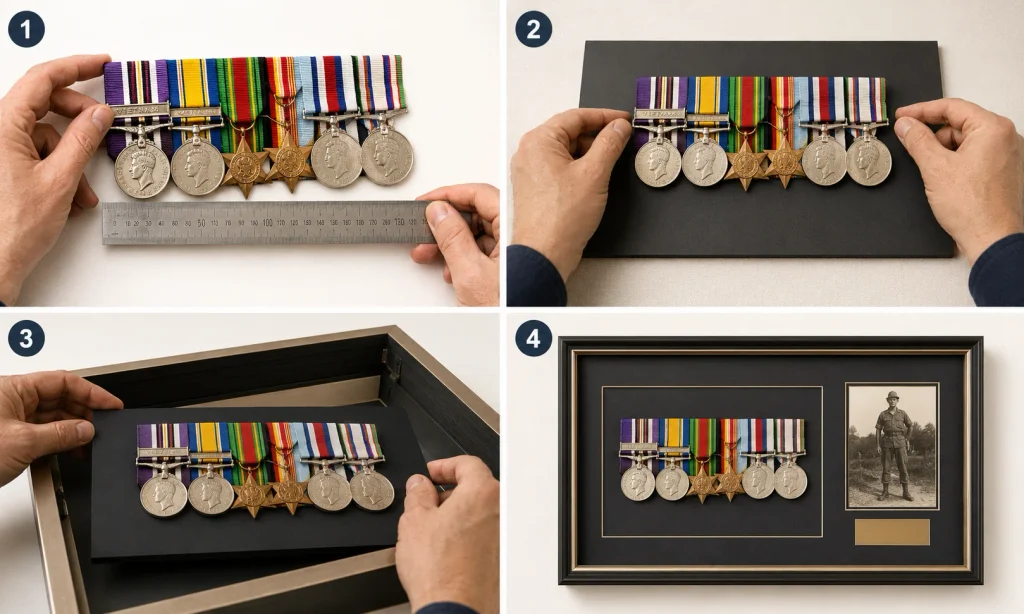
- Measure the full width of the mounted group, including the brooch pin, before choosing a frame size. Groups of four or five medals can easily exceed 300mm across.
- Use a shadow box style frame with at least 20mm clearance so the pin back doesn’t touch the backing board.
- Space each medal evenly using the existing brooch spacing as your guide. Don’t try to squeeze them closer together to fit a smaller frame.
- Balance the layout with any accompanying photograph or plaque, rather than pushing the medals to one side to make room.
Court-Mounted Medals
Court mounting is the more formal presentation, where medals are individually backed onto a stiff, straight board and held flat rather than hanging loose. It’s the style most veterans and collectors choose for display purposes rather than wear.
How to Frame:
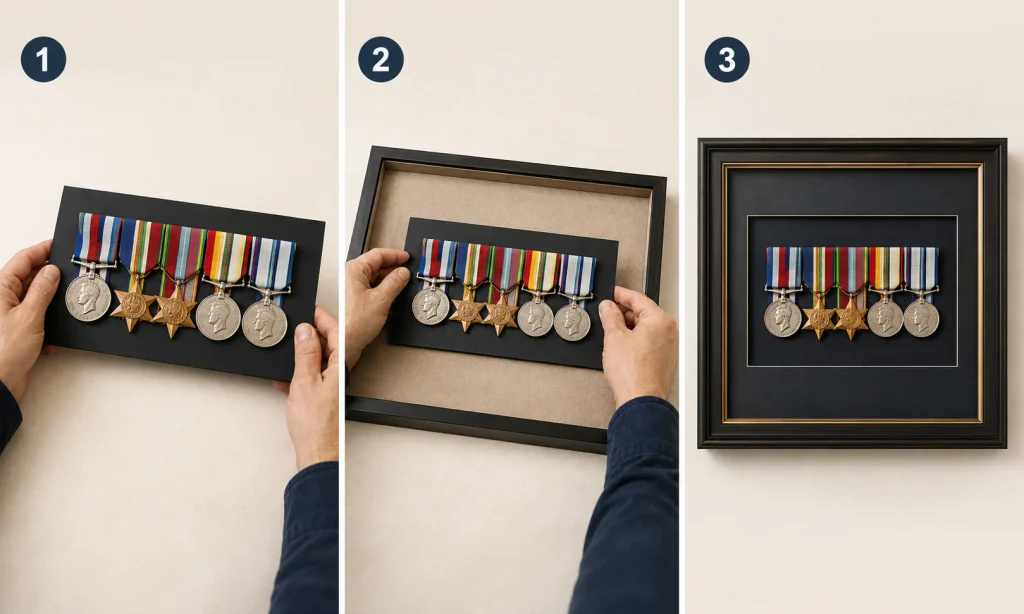
- Because court-mounted medals sit flat already, a shallower frame depth is usually fine, around 20–25mm.
- Mount the whole court-mounted board as one unit rather than removing individual medals, since separating them can damage the mounting.
- Pair court mounting with a suede or fabric mat board for a more formal, museum-style finish.
- If the group includes an Order of Australia medal or similar formal decoration, a darker mat with a gold inner border tends to complement it well.
Medals With Clasps and Bars
Clasps and bars record additional campaigns or commendations and sit on the ribbon itself, adding extra width and sometimes extra thickness to the medal.
How to Frame:
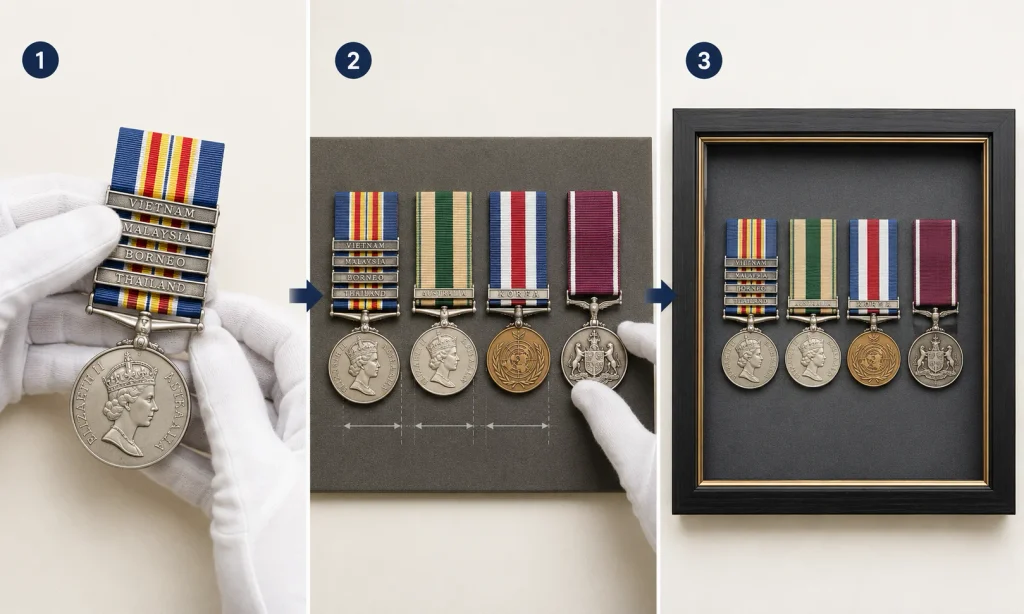
- Check clasp thickness before ordering a frame. Multiple clasps stacked on one ribbon can add several millimetres of depth that a standard frame won’t accommodate.
- Position clasps so their text or emblem faces forward and isn’t obscured by neighbouring medals.
- Use slightly wider spacing between medals with clasps, since the clasp width often exceeds the medal’s own diameter.
Ribbon Bars and Miniature Medals
Ribbon bars and miniatures are smaller representations, often worn on formal occasions instead of full-size medals. They’re frequently framed alongside the originals rather than on their own.
How to Frame:
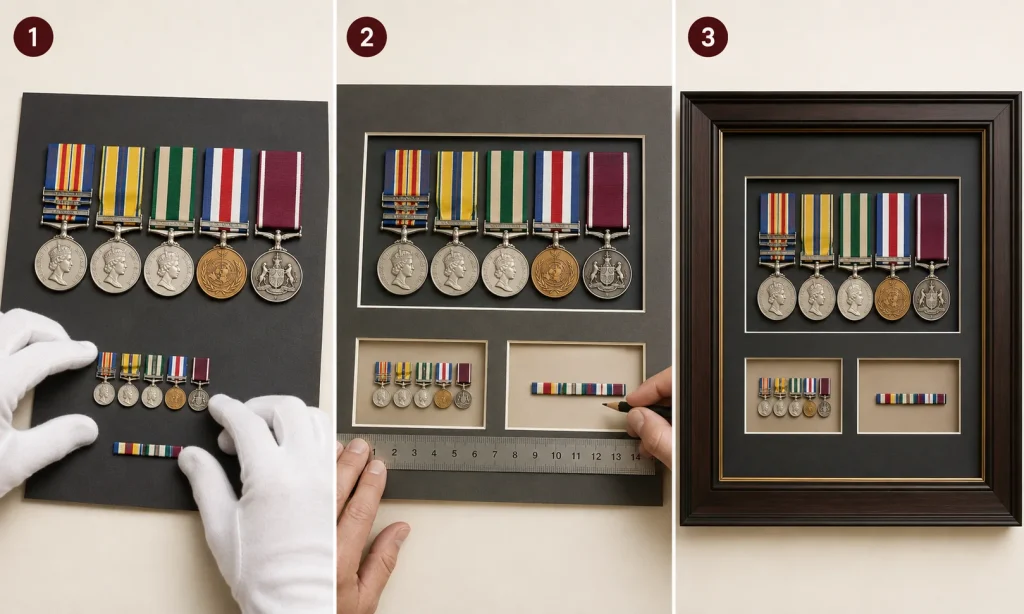
- Position ribbon bars or miniatures below or beside the main medal group, never overlapping them.
- Keep their scale in mind. A miniature next to a full-size medal can look mismatched if the spacing doesn’t account for the size difference.
- Use a smaller, separate mat opening if you want them visually distinct from the primary medals rather than blended into the same row.
How to Arrange Multiple Australian War Medals in a Frame
Multiple medals should be arranged in order of precedence, from the wearer’s right to left as they’d be worn on a uniform, following the Australian Order of Wearing. Getting this order right matters, particularly for veterans’ families who know the sequence well.
Beyond the order itself, a few things separate a tidy display from a cluttered one:
- Alignment – keep the top edge of every medal level, even if the medals themselves are slightly different sizes.
- Spacing – leave roughly equal gaps between each medal rather than eyeballing it. Small inconsistencies are very noticeable once framed.
- Ribbon direction – all ribbons should hang or sit at the same angle across the group.
- Clasps and bars – account for their extra width when calculating spacing, so the group doesn’t end up lopsided.
- Breathing room – don’t push medals to the frame edges. A narrow border of empty mat around the whole group makes the display look intentional rather than crowded.
What Can You Include in a War Medal Display?
You can include far more than the medals themselves, provided it doesn’t crowd the layout. A well-balanced military medal display often combines:
- Service photographs – a portrait in uniform or a group photo adds real context.
- Military badges – unit or corps badges placed near, not on top of, the medals.
- Ribbon bars – shown separately if the full medals are also present.
- Nameplates – engraved with rank, name, and service number for a finished, archival look.
- Service documents or memorabilia – discharge papers, campaign maps or small personal items, when there’s enough frame space to include them without overcrowding.
The aim isn’t to fit in everything available. A frame with three well-placed elements almost always looks better than one with eight competing for attention.
When Is Custom War Medal Framing a Better Option?
Custom war medal framing is the better option whenever a collection doesn’t fit a standard, off-the-shelf display size or format. This is more common than people expect. Mixed medal types, unusual ribbon widths, an added photograph, or a family group spanning two generations of service all change the dimensions and layout needed.
Off-the-shelf frames are built around average medal sizes and standard spacing. The moment you add a nameplate, a second photo, or a brooch-mounted group next to court-mounted ones, those templates stop working. Custom framing allows the depth, mat layout and spacing to be built around your specific medals rather than the other way around.
It’s also the safer route for older or more fragile medals, where the wrong mounting method can cause damage that isn’t easily reversed.
Create a Meaningful Display for Your Australian War Medals | Framous Picture Framing
At Framous Picture Framing, we work with families across Australia to frame war medals, service photographs and military memorabilia in a way that respects both the medals and the story behind them.
Every display is built around the specific medals involved, not a generic template. Browse examples of past medal and memorabilia framing in our gallery.
FAQs
How much does it cost to frame war medals in Australia?
Single medal framing starts around $150–$250. Full medal groups with photos, nameplates or shadow box depth range from $300–$800, depending on size and materials.
Do you need to clean or polish medals before framing?
No. Avoid polishing, especially older or tarnished medals, as it strips patina and reduces historical value. Leave cleaning to a specialist medal framer or restorer.
Can framed war medals still be worn on Anzac Day?
Yes, if mounted with a removable backing rather than sealed permanently. A professional framer can build the frame so medals unclip for wear, then refit easily.
Should I frame original medals or use replica medals?
Frame replicas if you want to keep wearing the originals or protect their resale value. Otherwise, well-mounted originals behind UV glass are perfectly safe to display.
What type of glass protects medals from fading and UV damage?
Use UV-protective, non-glare museum glass. It blocks ultraviolet light that fades ribbons and ages backing materials, keeping medals vivid for decades of display.
