
Posts By :

digital_admin

Picture Frame Size: 7 Design Tips to Choose the Perfect Frame (Australia Guide) 150 150 digital_admin

Picture Frame Size: 7 Design Tips to Choose the Perfect Frame (Australia Guide)

Picture Frame Size

One in every three Australian households has been investing in home improvements, particularly in wall styling, since last year. Yet still they struggle with one simple problem: choosing the right picture frame size.

The right frame size will directly make your wall look visually appealing. While the wrong photo frame size can make your walls empty, cluttered, or unbalanced.

In this guide, we’ll cover:

  • Standard photo frame sizes in Australia
  • How picture frame dimensions actually work
  • Practical design tips that help you get it right

But before choosing the design for your wall, let’s understand the basics of frame size and why it matters.

What Are the Standard Picture Frame Sizes in Australia?

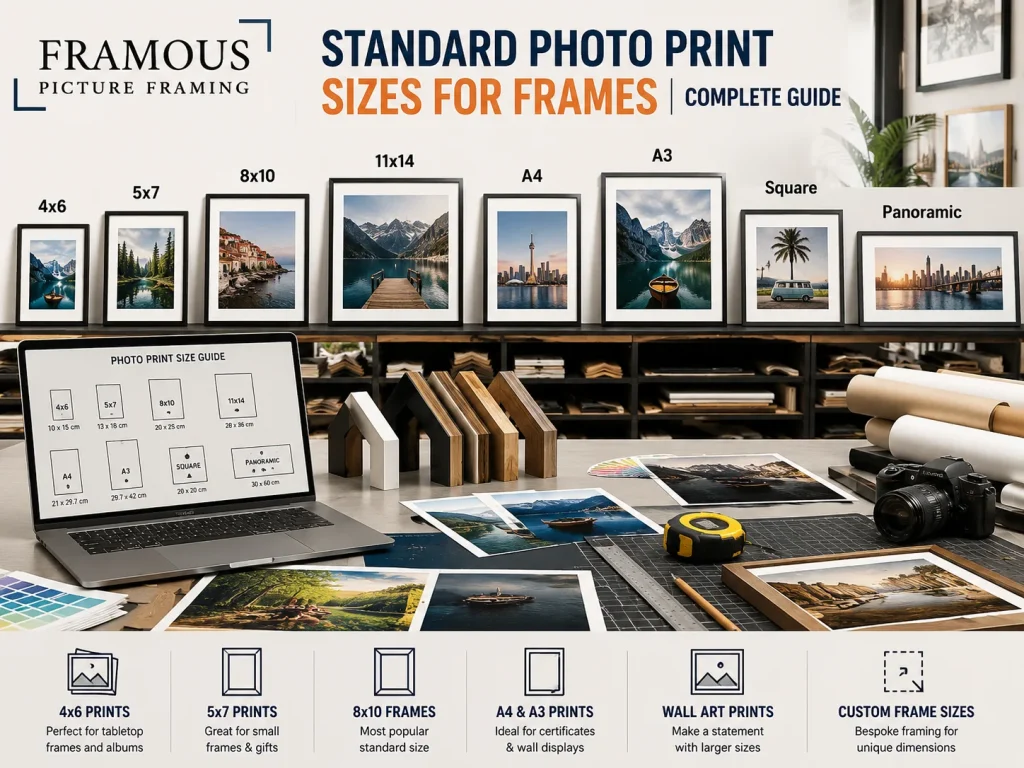
This table shows the most commonly used frame sizes in Australia.

Size (Inches) Size (Cm Approx.)Best For
4 x 610 x 15Small photos
5 x 713 x 18Portraits 
8 x 1020 x 25Desk frames 
11 x 1428 x 35Wall pieces 
16 x 2040 x 50Feature frames 
A4 21 x 29.7Documents/art 
A3 29.7 x 42Posters 
A2 42 x 59.4Large artworks

Why Picture Frame Dimensions Matter In Wall Decoration?

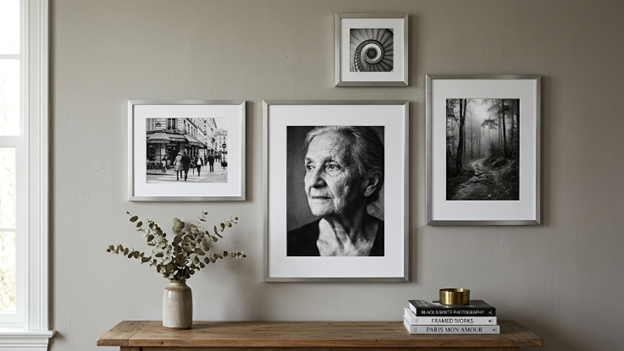
Picture frame dimensions matter in wall decoration because they can either enhance the look of the wall or make it look empty, cluttered, or visually boring. 

It is important to note that, when we mention picture frame dimensions, we are not talking about the outer edges of the frame, but the inner opening of the frame. 

And this is where many people get confused. 

If you want to understand how image frame size works in choosing the right frame in more detail, explore our guide on how to choose the right frame size and colour

But,  because a frame fits your photo, it does not mean it will look right on your wall.

So, let’s discuss design tips that make your walls look right with photo frames.

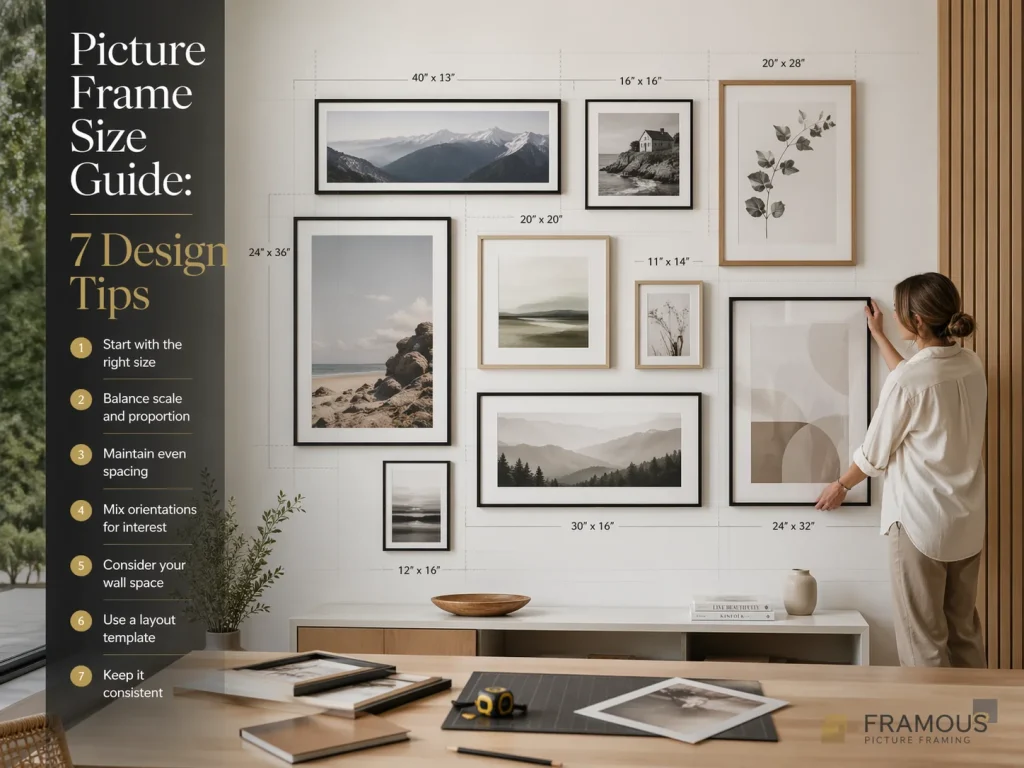
7 Design Tips to Choose the Perfect Frame Size

1. Think About the Wall First, Not the Frame

A common mistake that most people make is choosing a frame based only on the photo and not the wall as well.

And according to a good rule of thumb
Your framed piece should take up about 60–75% of the wall space it sits on.

This means if you have a large wall and choose a small frame, it will look awkward even if the measurement is correct. 

2. Frame Thickness Changes How Big It Feels

Two frames can have the same dimensions but feel completely different.

Why does this happen? That’s because of frame thickness.

  • Thin frames feel light and minimal
  • Thicker frames feel bold and take up more space

So when choosing framed picture sizes, don’t just think in terms of the thickness of the frame, but how they will look on the wall as well. 

3. Matting Can Completely Change the Size

Mat boards are one of the easiest ways to improve how a frame looks. They don’t just add style, they change scale.

Let’s understand it from the situation we witnessed with our previous customer. 

What happened was,

One of our customers brought an 8×10 photo and was expecting a compact frame for a simple look. But after discussing its presentation with our experts, we recommend adding a matt frame for visual balance. As a result, the final piece became 11 x 14 inches. 

So the artwork felt more prominent and shows that measured size may be correct, but the visual result depends on framing choices.

4. When in Doubt, Go Slightly Bigger

Many times, people get stuck while choosing the photo frame size for a wall. In such a case, it is recommended to purchase a bigger size. This is because large frames look more intentional on the wall as compared to the smaller frames. 

Here, choosing a bigger frame matters a lot when framing large photographs or creating a wall as a point of focus in a room. 

5. Match the Shape, Not Just the Size

Apart from the painting frame size, its shape matters too, but many people overlook this factor. So, instead of focusing only on size, pay attention to the shape and aspect ratio of the image as well.

For example

A 4:5 image fits naturally into an 8×10, and A 3:2 image works better in 6×4 or 12×8. But if you do not consider the ratios while choosing a frame

  • Your image may be cropped
  • Or you’ll need a mat frame

Understanding this makes choosing photo frame dimensions much easier.

6. Consider How Far Away You’ll View It

The place where you place your frame will also enhance the look of your picture. So,  

  • For a frame for small spaces like hallways, choose smaller frames as they will work well while looking closely at them.
  • For larger spaces like living areas, the bigger frames will work best. This is because people can see them from a distance.

Always think about how far away someone will be standing when viewing your artwork while getting a frame.

7. Keep Gallery Walls Balanced

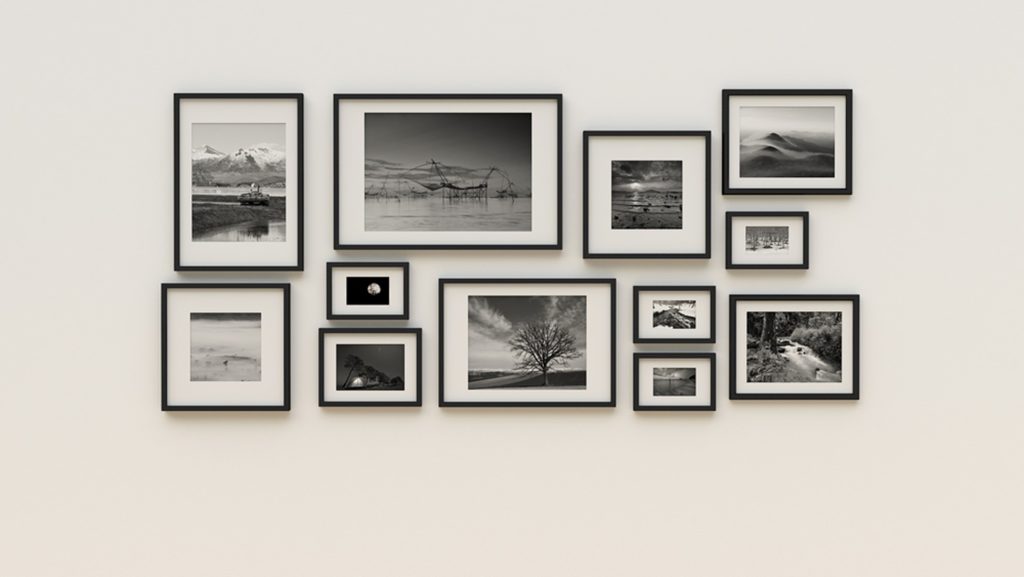
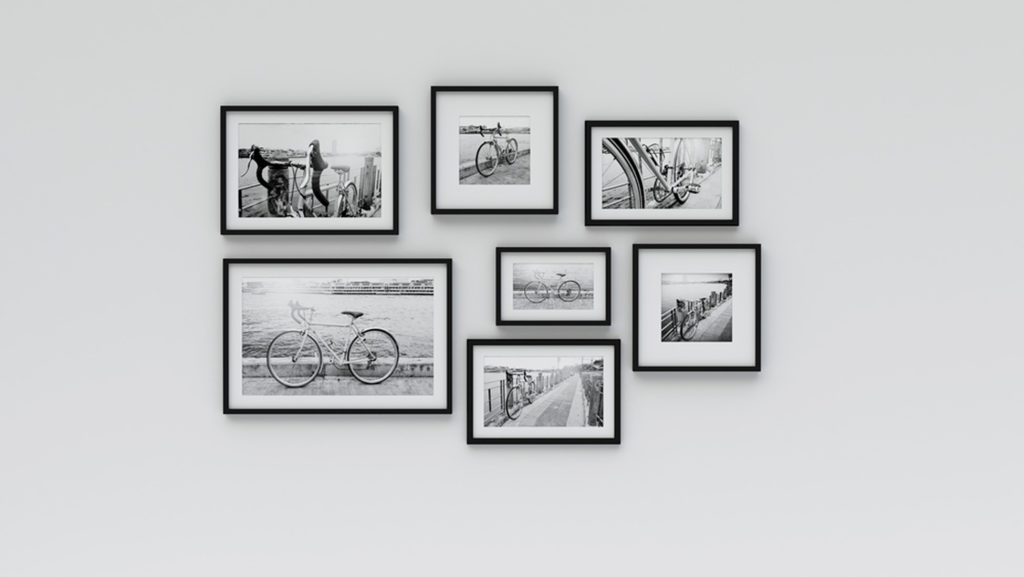
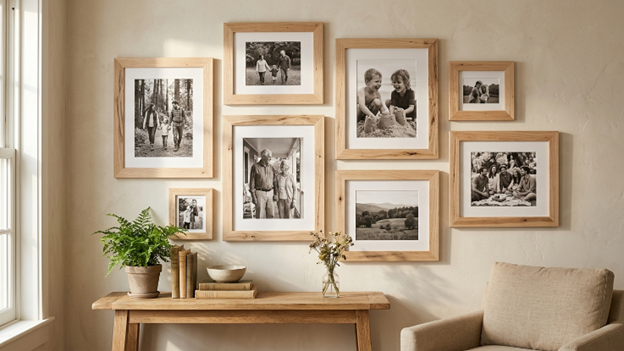
The easiest way to make gallery walls stunning is by using the same size frames, to create a clean and organised look. If you prefer a more creative style, you can mix different frame sizes, but make sure to keep the spacing between them consistent. This helps everything feel connected rather than scattered.

To achieve this, avoid random sizing that makes the wall look messy and unbalanced. A little accurate planning goes a long way in making your gallery wall look polished.

Common Picture Frame Sizes for Different Uses

Here are some recommended frame sizes for decoration.

  • Photos: 4×6, 5×7, 8×10
  • Artwork & Prints: 11×14, 16×20, A3
  • Paintings: Often need more flexibility, sometimes custom sizing
  • Documents: A4, A3

When Standard Frame Sizes Don’t Work

The standard frame sizes will not work when you have 

  • Framing large photographs
  • Canvas pieces
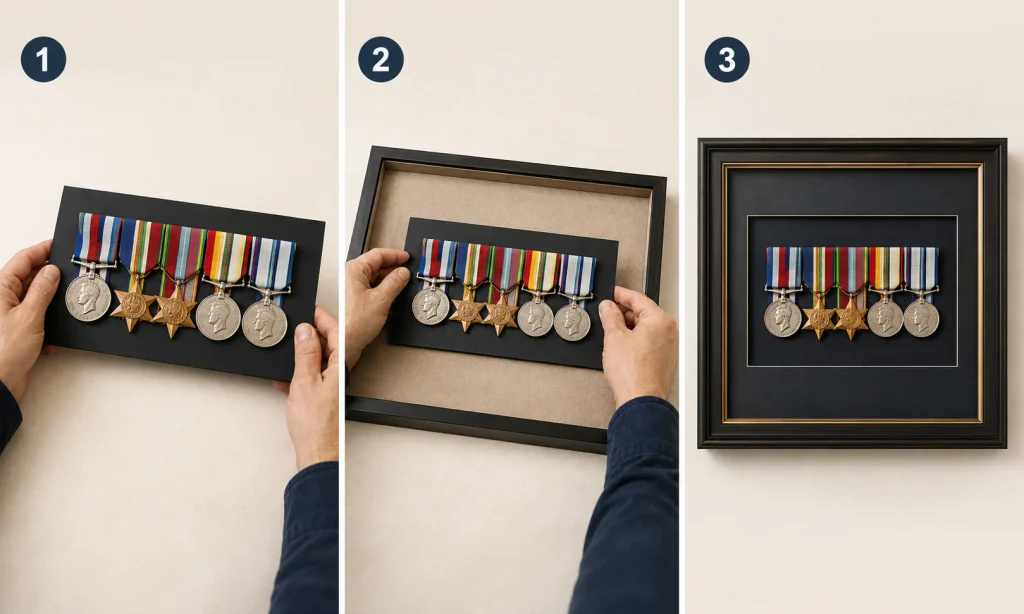
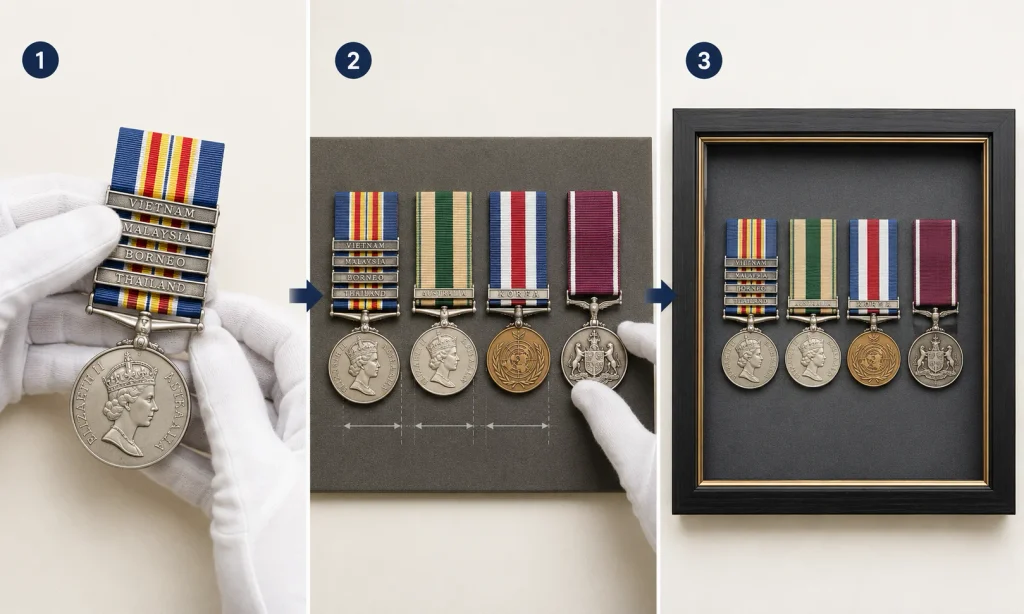
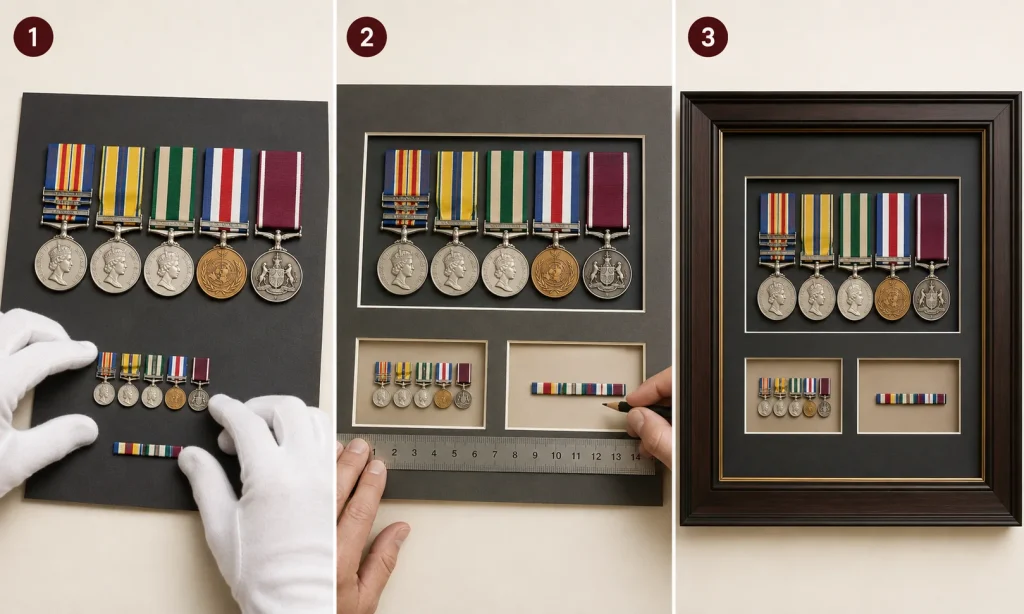
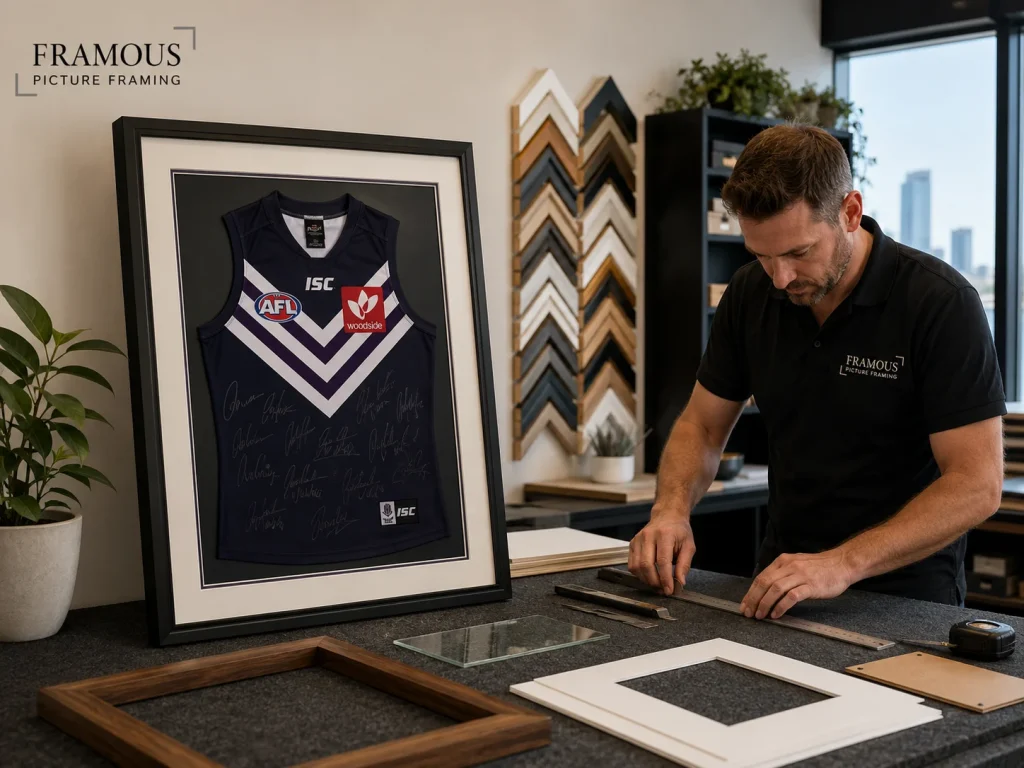
  • Sentimental items like jerseys or medals

And that’s where custom framing Perth becomes really useful.

So, instead of using a standard size, use the frame around the piece that actually gives a much better result.

Why Custom Framing Makes a Difference in Midland

Guessing the perfect size for your canvas is time-consuming and requires proper knowledge. So, if you’re in Midland or in Perth, picture framers can make this whole process much easier for you. They will 

  • Give proper sizing advice
  • Help with proportions
  • Guide on materials and finishes

Conclusion 

Choosing the right picture frame size isn’t just about frame size but about how the artwork, the frame, and the space around it come together:

When these elements are balanced, your artwork or photos will not just hang on the walls but will become part of the room. 

And if you are still confused, get an expert’s advice from Famous Picture Framing

Here is why homeowners in Midland trust us?

Since 1985, we have been offering.

  • Premium quality frames
  • Expert guidance
  • Great customer service

Contact us today for a quote or any guidance!

FAQs 

1- How to pick the right picture frame size?

Select according to the size of the artwork, the wall size, and the distance of viewing the artwork. Add a mat frame to get a better proportion and balanced visual rather than just the right frame size.

2- What is the 2 3 rule for hanging pictures?

The 2/3 rule states that the artwork must be approximately 2/3 the width of the furniture beneath it. This provides a visual balance and does not make the frame too small or overwhelming.

3- What are standard frame sizes in Australia?

Common sizes include 4×6, 5×7, 8×10, 11×14, 16×20 inches, and A4, A3, A2. These are the standard frame sizes that are compatible with most photos, artwork and posters.

4- Do picture frame sizes include the mat? 

No, frame sizes are the inner opening of the frame. The mat will result in a larger frame size and alter the appearance of the work on the wall.

5- What size frame should I use for large walls?

In the case of large walls, use larger frames or layouts in groups. Preferably, the artwork should occupy approximately 60-75% of the wall in order to provide a visually balanced look and attractive painting.

How to Choose a Frame for Black and White Photos 150 150 digital_admin

How to Choose a Frame for Black and White Photos

Frame for Black and White Photos

Black and white photos have a special kind of charm. They feel classic, stylish, and full of emotions perfect for turning your favorite memories into beautiful wall art. Whether it’s a family portrait, a travel moment, or a creative shot, black and white photography always stands out.

But choosing the right frame is what truly brings these photos to life. The right frame can highlight contrast, enhance details, and match your space perfectly, while the wrong one can take away from the image. At Framous Picture Framing, you can explore a wide range of styles, colours, and finishes to find a frame that complements your photo beautifully.

In this guide, you’ll learn how to choose the perfect frame for your black and white photos from selecting the right size and style to picking the best mat board so your pictures look even more stunning on your walls. A black and white photo in a black frame can create striking contrast, while other colours offer different moods.

Why Framing Black and White Photos Matters

  • Enhances visual depth – Frames can make light and shadow pop. Neutral-colored mats give the image room to breathe and add a sense of depth.
  • Highlights texture and detail – Since there’s no color, a good frame helps bring out fine details, like rough surfaces in landscapes or small expressions in portraits.
  • Creates a timeless, put-together look – Using matching frames (like black wood or metallic) across multiple black and white photos makes your display feel elegant and carefully curated.
  • Adds structure – Framing forces you to focus on composition, lighting, and shapes, turning busy scenes into stronger, more intentional images.
  • Sets the mood – Your frame is a creative choice. For example, a white mat can make a dark, moody photo feel even more dramatic, while a simple white and black frames combination gives a clean, modern look.

Emphasises Contrast and Texture

Frames can make light and shadow pop. Since there’s no color, a good frame helps bring out fine details, like rough surfaces in landscapes or small expressions in portraits. Choosing the right frame in black can anchor the image and intensify its drama.

Creates a Timeless and Elegant Look

Using matching frames (like black wood or metallic) across multiple black and white picture frame makes your display feel elegant and carefully curated.

Complements Your Interior Décor

Your frame is a creative choice. For example, a white mat can make a dark, moody photo feel even more dramatic, while a simple black frame gives a clean, modern look. Visit Framing Factory Midland to see how different materials work with your room’s existing palette.

Helps Rescue or Simplify Visual Focus

Framing forces, you to focus on composition, lighting, and shapes, turning busy scenes into stronger, more intentional images. A professional picture framing shop can guide you toward frames that simplify and strengthen your photo’s visual impact.

Step-by-Step Guide to Choosing the Right Frame

1. Decide on the Right Frame Size

The subtle nature of black and white photos means they’re perfect for a statement piece. You’ll get an impressive scale while still maintaining a balanced look in the room. Keep in mind, your photo will need to be high quality if you’re planning to blow it up. Wanting something smaller? Black and white photos also look great in small to medium frames. Use them as standalone artworks or display them in groups to create an eye‑catching feature wall. If you’re not sure what size is right for your wall, try cutting out paper rectangles to test it out. For custom framing Perth residents trust, Framous offers tailored sizing advice.

2. Select the Best Frame Style

Black and white photos go with a wide range of frame styles from classic slim frames to vintage style frames and more eclectic options. Minimalist frames are a good option if you want your wall frame to blend in seamlessly with your room decor or if you want to let the picture do all the talking. Ornate frames can add depth and texture to black and white photos, and work well as statement pieces. Vintage style frames are the ideal complement to antique black and white photographs, and they can also provide eye‑catching contrast for simple black and white artworks.

3. Choose the Perfect Frame Colour

For a classic, timeless look, go for white frames with a white mat, a great way to make the picture stand out and emphasise the texture. For a moodier look, consider black frames with either a white or black mat, which works well for dramatic landscapes and emotive portraits. Black and white photos also pair well with natural wood frames. If you’re looking for a touch of colour but still want to stay subtle, this could be the way to go. Love a pop of colour in your decor? Consider a coloured frame instead. For the best results, match the colour of the frame to the existing palette in your room.

4. Pick the Right Frame Material

Natural wood frames bring a subtle, organic feel that pairs beautifully with black and white photos. White frames and black frames offer a classic or moody foundation, while coloured frames add an eye‑catching pop. If you want even more depth, consider a shadow box frame it creates extra space and lets the photograph breathe in a unique way. Vintage style frames and ornate frames also add texture and depth, turning your artwork into a true statement piece.

5. Add a Mat Board for a Professional Finish

Most black and white photos work best with a mat board between the frame and the photo. This creates space, letting the photograph breathe. White or cream mat boards are the safest option, going well with almost every type of photo they make the artwork stand out while giving you a classic framed look. You can also play with the size of the mat. Sometimes black and white photos look great with a very wide mat. Using double mat boards is a good way to add depth. Want even more depth? Consider a shadow box frame.

Best Frame Styles for Black and White Photography

Classic Black Frames

Classic Black Frames

For a clean, minimalist look, sleek black frames are a go‑to choice for monochrome art. They extend the tones of the photo while adding crisp definition, making them ideal for modern interiors or galleries.

White Frames for a Minimal Look

Picture3

White frames bring softness and balance to black and white photos. They create a sense of space, making darker tones pop a perfect fit for contemporary or Scandinavian‑inspired décor.

Natural Wood Frames for Warmth

Picture4

To introduce a touch of warmth, consider natural or light wood frames. The organic tones create contrast without overpowering the photo, giving it an inviting, balanced presentation.

Metallic Frames for a Contemporary Touch

Picture5

Silver, pewter, or brushed gold frames add sophistication and edge. Metallics catch the light and work especially well with high‑contrast black and white images, adding an elevated gallery feel.

How to Display Black and White Photos

Before you start printing and framing your photos, it’s a good idea to think about how you’re going to display them. Knowing where and how you want to display your photos helps you make the right decisions when it comes to framing.

At Framous Picture Framing in Midland, we help you turn your black and white images into true showpieces – whether it’s a single dramatic statement piece above a fireplace, a gallery wall of family portraits, or a collection of small frames on a shelf or in an awkward corner.

Create a Gallery Wall

Display a range of wall frames at once. Keep them all black and white for a tidy, curated look, or mix and match as you see fit. The team at Framous can guide you on how to arrange different size pictures on a wall using our extensive range of moldings, matboards, and colours. Every gallery wall we help create is customised to perfection.

Match Frames with Room Style

Your room’s style matters. White frames bring softness and balance; black frames add crisp definition; natural wood introduces warmth; metallic frames add drama. Not sure what works? Our qualified colour theorist will walk you through all options – from frame styles and colours to mat board choices – so your black and white photos complement your space perfectly.

Common Mistakes to Avoid

  • Not planning your display before printing and framing.
  • Ignoring awkward corners – they are perfect spots for small framed photos.
  • Choosing a frame without expert advice – at Framous, we ensure your frame’s character and colour match the photo’s mood.
  • Forgetting about matting – white or cream mats help your photo breathe; double mats add subtle elegance. We’ll help you get it right.

Why Choose Framous Picture Framing

Since 1985, Framous Picture Framing, located in the heart of Midland, has been giving clients peace of mind for all their framing requirements large and small. We have the largest and most extensive range of frame moldings, mattings and decorative material from which to select, or you may simply choose to leave the design to our care.

Our award‑winning team will create something exceptional for you. Whether you know what you want or need the help of our qualified colour theorist and character assessor, you’ll be more than delighted with each and every individual frame creation. Satisfaction and Wow‑factor guaranteed.

Conclusion

Need advice about framing black and white photos? The team at Framous Picture Framing is here to help. We’ll walk you through frame styles, colours, mat boards, and more. Pop into our Midland studio: Tuesday–Friday 10am–6pm, Saturday 10am–1pm (Monday by appointment). Leave the design to us or bring your own ideas – you’ll be delighted with every custom creation.

A Guide To Different Framing Glass Types 150 150 digital_admin

A Guide To Different Framing Glass Types

A Guide To Different Framing Glass Types

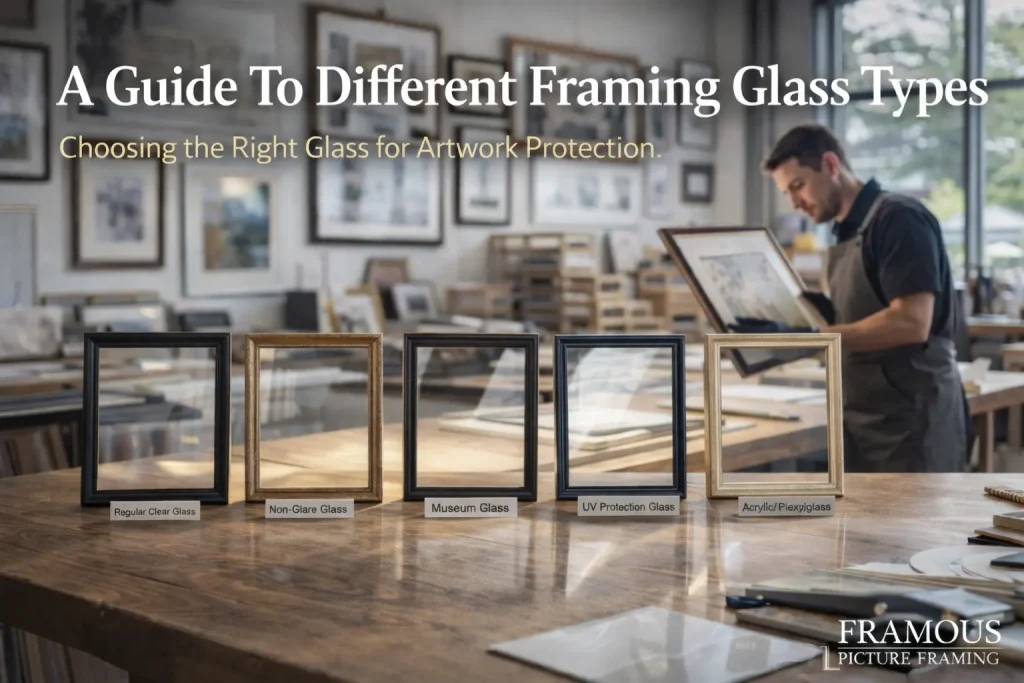
There are different framing glasses available, such as standard clear glass, anti-reflective glass, museum-grade glass and many more. Later in the blog, we will discuss all of them in detail.

Why is it important for you to learn about glass framing pictures?

Because if you choose the wrong type of glass, reflections will block your view, or sunlight will fade the image. But when you choose the right framing glass, your picture or artwork will stay protected for many years.

Without wasting time, let’s learn about the most common framing glass types and how to choose the right one for your frame. So you become knowledgeable enough that you will have no confusion when buying framing glass.

Read: Avoid These 9 Art Framing Mistakes – Protect Your Art with Expert Framers in Perth

Why Framing Glass Matters for Artwork and Photos

Many people think glass is just a protective cover, but it actually plays a much bigger role. The type of glass you choose affects both protection and visibility. For example, the wrong picture frame glass creates reflections that make it hard to clearly see the artwork.

Protection From Dust and Damage

If you use quality glass for photo frames, it will help in creating a protective barrier that keeps your artwork clean and safe. Glass protects your artwork from dust, dirt, and fingerprints. Without proper glazing, your photo or artwork can easily become damaged over time.

UV Protection and Colour Preservation

As we know, sunlight fades photographs, posters, and prints. Moreover, UV rays break down pigments in paper and ink. To overcome this, some advanced framing glass options can block up to 99% of ultraviolet light. So your artwork maintains its colours for many years. 

Improved Viewing Experience

Another reason to choose the right glazing is visibility. Many people notice strong reflections when they hang frames near windows or ceiling lights. Special glazing options reduce glare and make the artwork easier to see.

7 Major Framing Glass Types

There are many picture frame glasses available here in Western Australia. Each type of glass offers different benefits depending on your needs.

The most common types of framing glass are as follows:

  • Standard clear glass
  • Non-glare glass
  • Anti-reflective glass
  • UV protective glass
  • Conservation glass
  • Museum glass
  • Acrylic or plexiglass

Now let’s understand them in detail, one by one:

Standard Clear Glass 

Standard clear glass is the most commonly used glazing option in ready-made frames. Because of its simplicity, clear glass is often used in everyday glass frames for picture displays, such as family photos or posters.

Most frames sold in stores include this basic glass type because it is affordable and easy to produce. It is typically made from simple float glass that provides clear visibility.

Benefits of Clear Glass

The main benefit of clear glass is that it is one of the most affordable glazing options available.

Other advantages include:

  • Clear visibility
  • Easy replacement
  • Wide availability

For simple decorative frames, clear glass usually works perfectly fine.

Limitations

However, clear glass has a few drawbacks.

It does not provide UV protection, and it can create strong reflections under bright lighting. So, if you are framing something valuable or sentimental, you may want to consider a more advanced glazing option.

Non-Glare Glass (Matte Glass)

Non-glare glass is designed to reduce reflections. It has a slightly textured surface that diffuses light, which helps minimise glare.

This type of glazing works well in bright rooms where reflections can make artwork difficult to see.

Advantages

Non-glare glass is useful when frames are placed near windows or bright lights. It allows you to see the artwork more easily without strong reflections interfering with your view.

Non-glare glazing is recommended for hallways, offices, and living rooms.

Drawbacks

The main drawback of non-glare glass is that the textured surface can slightly soften the image. Because of that, fine details in photographs or artwork may appear a little less sharp compared to other glazing options.

Anti-Reflective Glass (AR Glass)

What Anti-Reflective Glass Is

Unlike non-glare glass, which uses a textured surface, this type uses special optical coatings that reduce light reflection. Anti-reflective glass is designed to reduce reflections while maintaining excellent clarity.

Key Benefits

One major advantage of anti-reflective glazing is how clear the artwork appears. You will notice:

  • Much less glare
  • Better colour visibility
  • Sharper image details

Because of the above benefits, many photographers prefer this glazing when displaying their prints.

Best Uses

If you want the artwork to look like there is no glass in front of it, anti-reflective glass will be an excellent choice. Anti-reflective glass is ideal for:

  • Photography prints
  • Art prints
  • Detailed illustrations

UV Protective Glass

UV protective glass helps block ultraviolet rays from sunlight. These rays are one of the main reasons artwork fades over time. If you use UV-blocking glass, it will keep colours bright and will prevent long-term damage.

Protection Level

Many UV-blocking glazing options can filter out a large portion of harmful UV rays. This makes them especially useful for frames placed in rooms that receive direct sunlight.

When to Use It

If your frame hangs near a window, UV protective glazing will be a smart choice. UV glass works well for:

  • Family photos
  • Posters
  • Printed artwork

Conservation Glass

While framing valuable or sentimental items, conservation glass is a go-to option for professional framers

Key Feature

Conservation glass can block around 99% of UV rays, making it one of the best choices for preserving artwork. This type of glazing helps in preventing fading and deterioration caused by sunlight.

Best Applications

Conservation glass is used for:

  • Certificates
  • Collectible prints
  • Historical photographs
  • Artwork with sentimental value

Many collectors prefer conservation glass to protect items for decades.

Museum Glass (Premium Framing Glass)

Museum glass is considered the highest quality framing glass available. It is commonly used in art galleries and museums. This glazing combines advanced UV protection with extremely low reflection.

Key Features

Museum glass offers several premium benefits that allow viewers to see the artwork clearly without glare. Some features include:

  • Very low reflection
  • High clarity
  • Around 99% UV protection

When to Choose Museum Glass

Museum glass will be best for:

  • Valuable artwork
  • Gallery displays
  • Rare prints

Acrylic or Plexiglass Framing

Acrylic glazing is a plastic alternative to traditional glass. Large frames use acrylic because it is lightweight and harder to break.

Benefits

Acrylic is commonly used when shipping artwork or installing large wall frames. Acrylic offers several advantages, including:

  • Lightweight material
  • Shatter resistance
  • Safer for large frames

Drawbacks

However, acrylic can scratch more easily than glass. It also builds up static electricity, which can attract dust to the surface.

ALSO READ: Custom Framing Cost: How Much It Costs to Custom Frame a Picture in Perth

How To Choose the Right Framing Glass

Imagine you frame your graduation photo and hang it near a sunny window. A few years later, the colours start fading because the frame used basic glass. So it is very important to choose the right framing glass. 

Choosing the right glazing depends on several factors.

Lighting Conditions

If your frame is in a bright room, you should choose anti-reflective or non-glare glass.

Artwork Value

For valuable artwork, conservation glass or museum glass will be best as they offer the best protection.

Frame Size

Large frames use acrylic because it is lighter and safer. So it is the best choice if you want to frame large pictures.

Top Picture Framers in Midland | Framous Picture Framing

The right framing glass protects your artwork and improves how it looks on display.

If you want expert advice or custom framing solutions, Framous Picture Framing offer professional services that will help you to choose the right glass for your frame. You can book a free consultation first, or just bring your artwork. We will take care of everything.

Click here and get in touch with us

Custom Framing Cost: How Much It Costs to Custom Frame a Picture in Perth 150 150 digital_admin

Custom Framing Cost: How Much It Costs to Custom Frame a Picture in Perth

Custom Framing Cost in Perth

Wondering why a normal frame can be under $50 while a bespoke job costs much more? Custom framing cost in Perth ranges from $100–$500. Small prints and photos usually fall between $190–$230, while larger or more complex pieces can exceed $500.

That’s because a custom frame isn’t just a decorative border; it’s a carefully designed system that fits, protects, and showcases your artwork or memorabilia for decades. The size of your item plays a major role in the price, but there are several other factors that can influence the final cost.

So, what exactly drives up the cost of custom framing?

This blog explains the real drivers of custom picture framing cost, shows price ranges, and gives practical tips to get the look, protection, and quality you want, without paying for features you don’t need.

So, let’s explore why investing in custom framing is worth every cent.

Factors That Affect Custom Framing Costs

Knowing what factors go into a custom frame helps explain price differences and lets you find the perfect balance between presentation, protection, and budget.

➔ Artwork Size & Complexity

Size is one of the single biggest cost drivers.

Larger pieces need more moulding, wider mats and larger sheets of glazing. They add handling and shipping complexity. Plus, they sometimes require special hanging hardware.

Three-dimensional or irregular items like jerseys, medals, hats, shadow-boxes and heavily textured canvases need custom mounts and extra depth in the frame, which increases both materials and skilled labour time.

Local Perth framers commonly publish size-based price guides for standard formats (A4 → A0) because it’s a quick way to estimate job cost.

➔ Frame Style & Material

The type of moulding you choose is a major line item. Mass-produced, off-the-shelf frames use low-cost materials that can warp or degrade. Custom framing gives you a wide range of materials like;

  • solid timbers
  • engineered timbers
  • aluminium
  • sustainable options like bamboo, reclaimed timber

Premium timbers, metal profiles, or ornate decorative mouldings are more expensive but they also define the look and longevity of the finished piece. Because custom mouldings are measured, cut and finished to order, the frame style and material selection usually accounts for a significant portion of the total price.

➔ Glazing & Protection Options

Glazing is one of the most value-dense upgrades in framing and one of the most frequent reasons prices vary.

Basic clear glass or standard acrylic is cheapest, but it offers limited protection against UV fading and reflection.

Premium options like UV-blocking glassconservation glass and anti-reflective “museum” glass, offer dramatically better light transmission and protection. Some museum-grade glazings block up to 99% of harmful UV and reduce glare while preserving true colour.

For valuable artwork or pieces that will hang in bright rooms, glazing choice can be worth the extra cost because it extends the life and appearance of the piece. For larger works, framers recommend acrylic alternatives for safety and lower weight, but premium acrylics can cost as much as specialty glass.

Read more > Modern Memorabilia Framing Perth: Preserve Your Memories for Years

➔ Mats & Borders

Mats do more than improve aesthetics. They provide a physical barrier so glazing never touches the artwork, which prevents moisture transfer, scuffing and adhesion problems over time.

Custom-cut, acid-free (archival) mat boards cost more than standard paperboard, and layered or bevelled mattes, multiple windows, or unusual colours and textures add both materials and labour.

For textiles or delicate works, spacers and sealed backing are sometimes used instead of, or in addition to, mats. These protective details increase cost but are essential for long-term preservation.

➔ Skilled Labour & Qualifications

Labour is not simply “time”; it’s trained skill. Picture framing at a professional level requires precise measuring, clean joins, correct mounting and conservation-aware techniques.

In Australia, the nationally recognised qualification for picture framers is Certificate III in Picture Framing (MSF30518). Framers with this training command higher rates because they deliver consistent, conservation-minded results.

When you pay for custom framing, part of what you’re buying is that expertise; safe handling of fragile pieces, accurate mat cutting, secure mounting, and a finish that won’t come apart after a few years.

➔ Craftsmanship, Machinery & Turnaround

High-quality framing combines hand skill with precision machinery. Framing shops that invest in digital cutters, precision guillotines, v-nailers and CNC-assisted joiners can deliver cleaner corners and more consistent mat openings, which reduces waste and rework. Those capital costs are reflected in pricing.

Some Perth framers offer same-day or fast turnaround options by using in-house equipment and stocked mouldings.

Faster turnaround can carry a premium, while longer lead times may lower the cost. If a framer provides on-site fabrication (rather than outsourcing), you’re paying for the convenience and quality control that comes with in-house production.  

Read more > How Long it Takes to Make Custom Frame

Why framing conservation choices add to price but save money long term:

Decisions such as using acid-free mats, sealed backing, UV-blocking glazing and proper mounting add to the upfront cost, but they reduce the need for future restoration and preserve colour and structure (especially in sunlight or humid Perth environments). For heirlooms, textiles and original artworks, these conservation investments prove cheaper than replacing or restoring a faded or damaged piece later.

Explore more details > Why Is a Custom Picture Frame Better Than a Normal Frame?

Custom Framing Price in Perth: Typical Costs Ranges

Here’s a realistic guide based on local pricing. Prices vary depending on frame size, style, mat board choice, glazing type (acrylic vs glass vs conservation glass), mounting method, and turnaround time. Use these ranges as a planning guide when budgeting your custom framing project in Perth.

Project TypePrice RangeNotes / Why the Price Varies
Small print or photo(standard timber moulding + clear glass)$190–$230Standard sizes and simple frames are cheaper; conservation mats or boutique mouldings cost more.
Large artwork(premium moulding + UV / conservation glazing)$700–$900+Larger pieces need more materials and stronger support; protective glazing adds cost.
Sports jersey or memorabilia(shadow box + acid-free mounts + spacers + glazing)$400–$800+Depth, mounts, mats, and glazing affect price; archival materials increase cost.

Smart Tips to Save on Custom Framing Without Losing Quality

Looking for ways to keep your framing budget under control? Here are practical, expert-backed tips that help you get a beautiful result without paying more than you need to:

➔ Choose Standard Sizes Whenever Possible

A4, A3, A2 and 12×16” frames cost less because they use less material and reduce cutting waste. Custom sizing increases labour and moulding cost.

➔ Pick Simpler, Modern Mouldings

Clean, minimal timber or aluminium profiles are not only affordable but also timeless. Ornate or deep decorative frames usually double the price.

➔ Use Standard Clear Glass for Low-Risk Pieces

If your artwork won’t sit in direct sunlight, standard glass or acrylic is perfectly fine and far cheaper than museum-grade glazing.

➔ Limit the Number of Mat Layers

One high-quality acid-free mat looks elegant and keeps costs lower than double or triple matting.

➔ Combine Multiple Small Prints Into One Frame

Instead of framing pieces separately, a multi-opening mat layout is often more affordable.

➔ Trust Your Framer’s Recommendations

Experienced framers know where you can simplify without risking damage or compromising the final look. A quick consult can save money and stress.

➔ Keep Turnaround Flexible

If you’re not in a rush, some Perth framers offer lower prices for standard lead times. Priority jobs can cost more.

➔ Bring Artwork Clean, Flattened and Ready

Extra preparation like cleaning, pressing, re-mounting adds to labour time. Delivering your item in good condition can reduce cost.

➔ Don’t Over-Specify for Low-Value Prints

Save museum-grade glazing for heirlooms, original artworks or valuable prints. Everyday posters and décor don’t need the highest preservation level.

Worried a cheap frame will damage your artwork, or cost you more to fix later?

Protect Your Artwork with Expert Custom Framing in Perth | Get Honest Pricing & Lasting Results

At Framous Picture Framing (serving Midland & greater Perth since 1985) we not only make frames; we build museum-quality systems that protect, present and preserve your photos, prints, canvases and memorabilia.

Whether you want archival framing for a treasured painting, a shadow box for a sports jersey, or a stylish everyday frame that looks great on your wall, our award-winning team gives clear advice, transparent custom framing cost estimates, and workmanship that lasts decades.

So, don’t wait any longer!

Get Your Free Custom Framing Quote Now

FAQs About Custom Framing Cost & Services

  • How much does custom framing cost in Perth?

Custom framing prices range from about $190–$230 for small prints to $700–$900+ for large, conservation-grade jobs; shadow-box memorabilia often sits around $400–$800+. Final cost depends on size, moulding, glazing and mounting choices.

  • How long does custom framing take?

Standard turnaround is usually 7–14 business days for most jobs; conservation or complex restorations can take longer. Ask for a priority fast-track if you need it sooner.

  • Do you offer conservation framing and museum-grade glazing?

Yes, we provide acid-free mats, sealed backing, and UV-protective or museum-grade glass/acrylic for long-term preservation, ideal for originals, photos and textiles exposed to light.

  • How can I lower the custom framing cost without losing quality?

Choose standard frame sizes, simpler mouldings, a single quality mat and standard clear glazing for non-heirloom pieces. Consult your framer to avoid over-specifying conservation products for low-value prints.

Avoid These 9 Art Framing Mistakes – Protect Your Art with Expert Framers in Perth 150 150 digital_admin

Avoid These 9 Art Framing Mistakes – Protect Your Art with Expert Framers in Perth

Empty,Wooden,Picture,Frame,Mockup,Hanging,On,Beige,Wall,Background.

Imagine your prized artwork losing colour or curling at the edges. Not because of age, but due to a simple framing mistake. In Perth, we’ve seen countless art framing mistakes cause costly damage like mat-burn and faded prints.

But don’t worry. Most errors are avoidable.

In this guide, we’ll expose 9 common framing mistakes and show you quick fixes to protect your art. Whether you’re DIY framing at home or choosing a custom framing service, read on for expert tips and tricks to keep your artwork safe and stunning.

9 Common Picture Framing Mistakes That Can Damage Your Artwork

Below are the 9 most frequent framing blunders. For each, we explain why it’s a problem, offer a DIY fix, and explain when a pro’s help is wise.

1. Choosing the Wrong Frame Size

    Using a frame that’s too big or too small throws off your artwork’s balance. An oversized frame can overwhelm a delicate print, while a tiny one makes a painting look cramped.

    A good rule: the frame (and mat) should complement the art, not overpower it. If the frame is mismatched, viewers’ eyes wander away from the art.

    Quick Fixes:

    • Measure the wall space and art first. Use a paper mock-up on the wall to preview different sizes.
    • Ensure there’s a comfortable border. Many professional framers use a 3:1 or golden-ratio guideline, so the art feels centered.
    • Contact us to calculate proportions precisely.

    2. Neglecting the Matboard / Doing Matboard Mistakes

    Mats do more than look nice. They protect and showcase art. Using acidic or the wrong mat width can actually damage your piece. Acidic mats produce “mat burn,” irreversibly browning your artwork. Also, a mat that’s too narrow can crowd the piece, while an overly wide one can dwarf it.

    Quick Fixes:

    • Always use acid-free, archival matboard (lignin-free) to avoid mat-burn.
    • A safe guideline is a 2–4″ mat border for average artwork (wider mats for large art, narrower for small pieces).

    At Framous Picture Framing, we stock only museum-grade, acid-free mats. We’ll choose the right mat colour and width for “breathing room” around your art, enhancing the image with complementary neutrals (white, black, cream) rather than clashing hues.

    3. Ignoring the Artwork’s Style / Choosing the Wrong Frame Style

    The frame style should match the art and your room. A hyper-modern abstract in a heavy golden frame (or vice versa) can look discordant.

    For example, a minimalist line drawing might be overwhelmed by an ornate, heavy frame, and a grand oil painting can vanish in a too-simple frame. Even the frame’s finish (wood, metal, painted) should harmonize with the artwork’s era and colors.

    Quick Fixes:

    • Match the frame’s formality to the art’s.
    • Use simple black or white frames for modern or colourful pieces, and richer wood or decorative frames for classical or vintage art.
    • Consider your wall décor too – neutrals (white, black, wood tones) usually work well.

    4. Improper Mounting & Fixing

    How you fix the art in the frame is critical. Taping or gluing your artwork directly can cause stains or tears. For paper art, avoid aggressive adhesives.

    Conservation framing dictates acid-free hinging and reversible mounting. Use archival paper hinges with water-soluble paste (so everything can be removed later). Similarly, never let art touch the glass. Pros use spacers to keep glass off the surface which prevents sticking from humidity.

    Quick Fixes:

    • Don’t use regular tape or permanent glue.
    • If framing a print or photo, use archival corner mounts or linen tape with reversible adhesive.
    • For canvases, make sure the canvas is evenly stretched and secured as loose corners or slack canvas leads to sagging.
    • Check for wrinkles or over-stretch: canvas must be taut (not bubbled or drooping).

    5. Matching Frame and Mat Colour: Contrast Matters

    Using the same colour for frame and mat can flatten the look. A mat’s job is to draw the eye to the art, not become the focus. A bright mat or frame colour that mirrors the artwork’s main colour can overpower the piece.

    Quick Fixes:

    • If your frame and mat match too closely, switch one: e.g., use a light or dark neutral frame with the existing mat (or vice versa).
    • Opt for contrast: a neutral mat (white, off-white, black) often makes colours pop. If using a coloured mat, pick a subtle accent shade (like a muted blue or green) that highlights but doesn’t steal focus

    Come to us. We use colour theory in framing. Our framers will suggest frame/mat combinations.

    6. Hanging Art Too High

    Even a perfectly framed piece looks odd if hung too high.

    The standard rule is to hang art so its center is about 57–60 inches from the floor (average human eye level).

    Quick Fixes:

    • Mark 57″ on your wall, measure your artwork’s center, and align them. Use picture hanging hardware at that height.
    • If above a couch, ignore the 57″ rule and instead keep 6″ between couch and frame bottom.
    • For grouped pieces, treat them as one unit: align the group’s collective center around eye level and space each about 3–6 inches apart.

    Our framing shop can help plan complex layouts. We often recommend an L-bracket or rail system for heavy or multi-piece arrangements to ensure everything hangs straight and at the ideal height.

    7. Using Wrong or Unsafe Hanging Hardware

    Many framing disasters happen simply because the hanging tool wasn’t up to the job. Always match your hardware to the frame’s weight.

    A good rule: use hangers rated for 1–3 times the frame’s weight.

    Quick Fixes:

    • Check the weight rating on any hook or wire.
    • For medium frames, use heavy-duty picture hooks or wall anchors, not just a single nail.
    • For heavy or large frames, install two D-rings and sturdy picture wire so weight is distributed.
    • Use wall anchors suited to your wall type (toggle bolts for drywall, masonry anchors for brick/plaster).
    • Never trust flimsy sawtooth hangers with heavy art.

    We use museum-quality hanging systems. We can install security hardware and lead anchors to brace corners. This prevents unwanted shifts or falls, especially in high-traffic or earthquake-prone areas.

    8. Cheap or No Glazing / Skipping UV/AR Glass

    Cutting corners on glazing leaves artwork exposed to dust, UV fading and distracting glare. Proper glazing (UV-filtering glass or acrylic, and anti-reflective/AR options) protects colour, reduces reflections and preserves value; especially for works in bright rooms or near windows.

    Quick fixes — practical glazing tips you can apply today:

    • Choose UV-filtering glazing when the piece gets sunlight or strong artificial light.
    • Pick anti-reflective (AR) glass for glossy photos or framed prints so viewers see the art, not themselves.
    • Opt for acrylic for large or vulnerable frames: it’s lighter and shatter-resistant.
    • Use spacers to keep glazing off the artwork so paper/canvas won’t stick in humid conditions.
    • Seal the frame edges to reduce dust and moisture ingress.
    • Avoid direct sunlight where possible; even UV glass slows fading, it doesn’t make art invincible.
    • Consider window films or blinds as an extra layer of protection for sunny rooms.

    Pro-grade option: For valuable or sentimental pieces, use museum-grade glass or conservation acrylic. We use options with 99% UV protection and AR coatings. We’ll match glazing to the artwork’s value and display conditions so you get the best clarity and long-term protection.

    9. Choosing Price Over Materials

    Saving a few dollars on frame materials can backfire. Low-quality frames use acidic backing boards, non-archival tapes, or unsealed wood; all of which can invite mold, pests or paper decay. Cheap backers and tapes fail to buffer moisture and acidity, so over years, you risk foxing, warping or even bug damage. In the long run, cheap framing can mean expensive restoration or replacements.

    Quick Fixes:

    • Inspect any frame kit for “acid-free” labels.
    • If backing looks brown or flimsy, replace it with pH-neutral board.
    • Apply archival sealing tape around edges to block out dust and bugs.

    We do archival framing in which we use acid-free backing, spacers, and conservation tape to protect your art against humidity and insects.

    When to Call a Professional Framer in Midland, Perth

    Some framing jobs really need expert hands. If your piece is expensive, delicate or one-of-a-kind like oil paintings on canvas, delicate textiles or family heirlooms, it’s wise to call a pro. Complex pieces (multi-panel art, curved objects, heavy canvases) or any artwork that you want to preserve for generations should be professionally framed.

    Reach Out Framous Picture Framing in Perth: Award-Winning Framers Protecting Artworks Since 1985

    We use museum-grade, archival materials and even offer restoration services. DIY framing is often “not ideal” for original art; a skilled framer will follow industry standards and protect your investment.

    Whether you have a priceless gallery canvas or a sentimental print, our Midland framing workshop can help.

    Book a free framing consultation

    Or just bring your art to our frame showroom – our expert framers will ensure it’s framed perfectly and safely.

    FAQs

    • What are the most common framing mistakes?

    Common framing errors include wrong frame size (too big/small), non-archival mats (causing “mat burn”), skipping UV-protective glazing, using tape/glue on art, and poor hanging hardware. In short: wrong proportions, acidic materials, inadequate mounting or protection are the major pitfalls.

    • Is UV glass always necessary for art framing?

    It depends. For valuable art or pieces in bright light, UV-filtering glazing is highly recommended to prevent fading. Premium museum or conservation glass blocks 99% UV. For casual or dimly-lit displays, standard glass or acrylic may suffice, but we still suggest at least some UV protection if possible.

    • Can I frame delicate textiles at home?

    Generally, no. Fragile fabrics should be mounted with special supports and spacers to avoid damage. Improper DIY methods like taping or tight stretching can permanently distort or stain fabrics. Consult a professional framer for embroidery, tapestries or anything with fragile fibers.

    • How wide should a mat be for my artwork?

    A common rule of thumb is to allow at least 1–2 inches of mat showing on each side. Many framers use 2–4 inches for small to medium pieces, and proportionally wider mats for larger art. The goal is to give the artwork “breathing room” in the frame.

    • How high should I hang artwork in my home?

    Aim to keep the center of the artwork around 57–60 inches from the floor (eye level). If hanging above furniture (sofa, mantel), you can go a bit higher which is usually 6–8 inches above the furniture surface. For groupings, treat the collection as one big piece and center that unit near eye level.

    • What is the golden ratio in art framing?

    The golden ratio is a compositional guideline (1:1.618) used to achieve pleasing proportions. It’s like an advanced rule-of-thirds that divides space in a way that feels naturally balanced. In framing, some artists apply it to decide mat borders or focal placement, ensuring the artwork hangs in harmony with its frame and surroundings.

    Guide to Movie Memorabilia Framing in Perth | Frame Movie Poster Without Losing Its Vintage Charm 150 150 digital_admin

    Guide to Movie Memorabilia Framing in Perth | Frame Movie Poster Without Losing Its Vintage Charm

    Movie Memorabilia Framing in Perth Frame Movie Poster Without Losing Its Vintage Charm

    Worried your vintage poster or signed prop will fade or tear? Proper movie memorabilia framing is the first step to protect these treasures.

    Expert framers like Framous Picture Framing in Perth offer archival techniques that keep your pieces looking fresh and valuable.

    This guide covers everything; from what counts as memorabilia and conservation materials to step-by-step framing, fixing common issues, pricing, and movie poster display ideas. So, keep reading to learn how to preserve your movie memorabilia and turn them into stunning wall art.

    Why Frame Movie Memorabilia: Protect Value & Preserve Vintage Charm

    Framing isn’t just about display; it protects your collectible’s value and charm. Vintage posters and props are mostly printed on wood-pulp paper or delicate materials that yellow, fade, or tear over time.

    Archival framing uses UV-filtering glass, acid-free mats, and sealed backing to shield these items from sun, humidity, and dust. For example, Museum Glass blocks up to 99% of UV light and virtually eliminates reflections, preserving colour and detail. Even standard glass only stops UVB but allows about 75% of UVA to pass through. So, investing in museum-grade glazing is key.

    And more importantly, handing a memorabilia or collectible to a professional and qualified framer also safeguards provenance and gives you peace of mind.

    What Items Count as Movie Memorabilia? How They’re Different to Frame?

    Movie Memorabilia

    Each type has its own framing challenge – from paper’s sensitivity to textile weight – but the goal is the same: protect and showcase each piece as part of your personal film gallery.

    Item typeWhat makes it differentBest frame type
    Movie postersThin, fragile paper that can yellow, tear or creaseFlat custom frame with archival mat and UV glazing
    Autographs & signed printsInk can smudge or fade from light or contactFlat frame with a mat (or Mylar corners) and UV glazing
    Costumes & textilesBulky, heavy, and can be crushed or creasedDeep shadow box or custom box frame with internal supports
    Props & 3D objectsRigid shapes and varied thicknessesDeep shadow box / display case sized to the object
    Other collectibles (reels, scripts, tickets, awards)Mix of paper and 3D items; each needs a custom approachSmall frames for paper; shadow boxes for 3D

    Which Glazing and Mat Should I Choose for Movie Memorabilia Framing?

    Custom framing involves specialised materials. Below we’ve listed common options for glass and mat materials to help you choose the best combination:

    Glazing Options

    1. UV-Protective Glass Framing

      Premium glass designed to block the vast majority of damaging UV light and preserve colour and paper fibres. Ideal for high-value posters and signed items.

      Pros:
      • Blocks up to 99% UV; greatly slows fading
      • Very clear, low reflection (excellent display quality)
      Cons:
      • High cost
      • Heavier and more fragile than acrylic

      2. Museum-Grade Acrylic Framing

      A shatter-resistant acrylic glazing with museum-level UV protection. It’s a great choice for oversized frames or places where glass breakage is a concern.

      Pros:
      • Lightweight & unbreakable (safer for large frames)
      • High UV protection and anti-reflective options
      Cons:
      • Prone to surface scratches
      • Attracts static/dust; slightly different optical feel to glass

      3. Anti-Reflective Glass Framing

      Glass treated to reduce surface reflections. It’s useful where room lighting or spotlights would otherwise cause glare.

      Pros:
      • Cuts visible reflections and improves viewing under light
      Cons:
      • Often lacks full UV protection (check specs)
      • Still heavy and can break

      4. Standard Float Glass Framing

      The basic, inexpensive glazing found in many ready-made frames. It’s suitable for low-value or temporary displays.

      Pros:
      • Low cost and widely available
      • Optically clear for casual use
      Cons:
      • Minimal UV protection (much UVA passes through)
      • High glare and no shatter resistance

      Shadow Boxes (For Costumes, Props and 3D Items)

      Shadow Box Framing

      Shadow boxes are deep frames designed for bulky or three-dimensional memorabilia like costumes, helmets, trophies and props.

      Choose a shadow box with enough internal depth so the item does not touch the glazing. It’s usually 50–100 mm (5–10 cm) for most textiles and 100–150 mm (10–15 cm) or more for bulkier props.

      For the front glazing, museum-grade acrylic is a great choice for large or heavy shadow boxes because it is lightweight and shatter-resistant. Museum glass can be used if you prefer the look of glass and the frame will be safely mounted. Inside the box, use padded supports, sewn loops, pedestals or discreet brackets to hold items securely. Leave an air gap to avoid crushing. Seal the back to keep out dust and pests. But make sure there’s no trapped moisture.

      Speak to your framer about edge sealing vs. ventilated backs for very old textiles.

      Matboard Options

      Matting (the board that sits between your artwork and the frame) does three jobs:

      • creates a visual border
      • keeps the artwork away from the glazing
      • provides an archival buffer that protects paper from acids and moisture

      Good matting is essential for poster preservation framing and for professional custom picture frames Perth, It both improves the look and extends the life of your movie memorabilia.

      So, there are three main matboard options:

      1. Standard (non-archival)
      2. Alpha-cellulose (conservation)
      3. Cotton-rag (100% cotton)
      TypeWhat it isBest for
      Standard (non-archival)An economy matboard made from ordinary wood-pulp paper.Use this only for short-term or low-value displays because it is inexpensive but contains acids that will yellow and can damage artwork over time.
      Alpha-cellulose (conservation)An acid-free matboard made from purified wood pulp or cotton linters.This is a good archival option for most collectors. It offers protection, a wider range of colours and textures, and good value.
      Cotton-rag (100% cotton)A premium, 100% cotton matboard with museum-level preservation and a luxurious finish.Choose this for heirlooms and very high-value pieces because it is pH neutral, resists yellowing for decades, and gives the best long-term protection.

      Tip: whatever mat you choose, pair it with acid-free hinges/tapes and UV protective glazing to maximise poster preservation.

      Mounting Options: Why Avoid Dry-Mounting?

      Use reversible, conservation-grade mounting techniques, so items can be removed later:

      • Hinge mounting (top edge only) or Mylar corners for paper items.
      • Sewn loops, padded supports or cloth ties for textiles.
      • Velcro/straps or fixed mounts for hard props.

      Dry mounting (heat-pressing paper to backing) is avoided for collectibles. It’s because it permanently glues the item and can ruin resale value. Instead, corners or archival hinges are used so your poster or photo can be removed later if needed.

      How to Frame Movie Memorabilia Like A Pro: Step-by-Step Guide

      Custom framing is a careful process. Here’s how a professional framer handles movie collectibles:

      Step#1: Assessment & Authentication:

      Examine the item’s condition (tears, wrinkles, water damage) and authenticity (signatures, COAs). Take photos and measurements. Discuss restoration needs. Minor tears can be mended with archival tape on the back. But severe damage could need a conservator.

      Check if a Certificate of Authenticity should be saved as many framers add a pouch behind the mat. Confirm framing goals like is it a gift, long-term display, or auction item?

      Step#2: Design & Mockup:

      Choose frame style, mat colour, and glazing that match the memorabilia and room. Most shops use software or sketches to preview layouts.

      For example, a black-and-white theater poster might suit a black frame and white window mat for contrast. Whereas, a colourful sci-fi poster could pop with a sleek metallic frame. Size the mat window carefully. It should reveal the artwork fully without hiding any important details. Clients approve the mockup before production.

      Step#3: Materials Selection:

      Order or cut the frame moulding, mat board, backing, and glass/acrylic. For valuable collectibles, select archival supplies; UV-filtering Museum Glass or Optium acrylic, and conservation-grade matboard.

      If the piece is a document or photo, pick 100% cotton rag mats. For less pricey items, a good-quality alpha-cellulose mat still protects well.

      Step#4: Conservation Mounting:

      Mount the item using reversible techniques. For paper posters, affix acid-free linen tape to the top edge only (a “hinge mount”) so gravity holds it flush.

      Use corner-mounts for posters if preferred (little Mylar pockets glued to the mat corners). Never use sticky tape or glue directly on the artwork. For heavier items, position it on the backing board and fasten with cloth ties or Velcro straps at inconspicuous points.

      Seal the back with buffered or plain white backing board and tape.

      Step#5: Glazing & Sealing:

      Place the selected glass/acrylic in the frame. Then insert the mounted item and backing. Framers often use silicone or cloth-backed tape to edge-seal the package, keeping out moisture and pests.

      Attach dustcover paper (acid-free) to the frame’s back for a finished look. Ensure the glass is spotless inside and out, even specks can be magnified later.

      Step#6: Quality Check & Delivery:

      Inspect the framed piece thoroughly. Check for dust, fingerprints, or misalignments. Weigh the frame in hand to ensure safety of hanging hardware. Typical turnaround for custom framing is 2–3 weeks (rush jobs are sometimes available).

      Finally, either carefully wrap the artwork for pickup or schedule an installation.

      Common Poster Problems & Framing Fixes

      • Removing Wrinkles:

      Small folds or ripples can sometimes be gently flattened. Some experts suggest placing the poster image-down on a soft surface, covering it with a slightly damp clean cloth, and using a cool iron on low heat to relax creases.

      Alternatively, stacking the poster under a heavy glass pane for days can slowly flatten it.

      Do not spray water directly or iron at full heat as this risks ink bleed or scorching.

      • Fixing Water Damage & Foxing:

      Water spots and brown “foxing” on paper come from humidity and mould.

      Minor foxing might be lightened by a professional using gentle chemicals. But DIY methods (lemon juice, bleach) will harm the paper.

      At minimum, remove acidic backings and store at stable humidity (40–60%) to prevent further spread. Framers avoid laminates or glues near foxed areas and may recommend leaving stains untouched if treatment is too risky.

      • Will Framing Remove Creases?

      Unfortunately, mounting in a frame cannot erase deep fold lines. But truly creased poster may benefit from professional linen-backing; a process where the artwork is relined onto a canvas, smoothing out wrinkles. Though this is an advanced conservation step usually reserved for high-end restoration.

      Pro Tip: The key is prevention: using poster preservation framing (archival mats and UV glass) will keep new creases and fading at bay. Even with the best care, paper will age, so display your framed memorabilia away from direct light, and consider replacing UV glass every few decades for maximum protection.

      Movie Memorabilia Framing Costs in Perth: A Practical Pricing Guide

      How much does it cost to frame a movie poster in Perth?

      Framing a movie poster in Perth costs between $200 to $500, depending on size, materials, and preservation options like UV glass and archival mats.

      Here’s a quick breakdown of common movie memorabilia framing costs in Perth:

      ServiceApproximate Price (AUD)Notes
      Ready-made Poster Frame (e.g. 24×36)$70 – $80Basic plastic or wood frames from stores. Size and matting vary price.
      Custom Poster Framing (standard)$150 – $400Includes custom-cut frame, mat, UV glass. Size & frame style affect cost.
      Shadow Box (costume/3D item)$600 – $1,200+Larger/deeper case required. Cost rises with size and depth.
      Premium Conservation Framing$700 – $2,000+Museum-grade moldings, UV museum glass or acrylic, cotton mats. High-end service.

      Remember, high-quality framing is an investment: paying more initially protects the poster’s value and saves replacement costs later.

      Movie Memorabilia Display Ideas: Make Cinematic Wall Art That Wows

      Want your movie collection to feel like a mini gallery? These display ideas for movie memorabilia turn your collection into a curated art installation. Here are three smart ideas:

      1. Gallery Walls & Arrangement

        Mix posters, photos, and small props in a themed layout; by era, colour, or genre. Start with a central piece, then build around it using consistent spacing, matching mats, or similar frames. Black or white frames work well to unify eclectic collections.

        2. Lighting & Glare Solutions

        Use adjustable LED picture or track lights to highlight your display. Non-reflective glazing like museum glass or Optium acrylic reduces glare, while UV-blocking shades protect from sunlight. Warm accent LEDs can spotlight signatures or rare posters safely.

        3. Themed Framing Styles

        Match frames to the movie era. Like ornate wood for classics, sleek black or silver for modern sci-fi. Create cohesion with retro tones for vintage films or minimalist black-and-white for Noir. For a bold touch, use coloured mats or frames that nod to the film itself.

        Worried your treasured posters or props might fade away?

        Let Us Preserve and Frame Your Movie Memorabilia for Lasting Protection & Stunning Display

        With custom picture framing in Perth, we use archival materials, UV-filtering glass, and expert mounting techniques to keep your movie memorabilia safe and stunning.

        Visit our Midland shop or contact us today for a free quote, quick design consult, or to upload photos of your pieces for assessment.

        Keep your film history looking like the star it is!

        Call (08) 9274 1453 or Request a Free Quote Now

        How To Create a Mirror Frame? Easy DIY Mirror Framing Guide 150 150 digital_admin

        How To Create a Mirror Frame? Easy DIY Mirror Framing Guide

        Create a Mirror Frame

        A mirror without a frame feels unfinished, like a painting without a border.

        A thoughtfully crafted mirror frame doesn’t just tidy up the edges. But brings warmth, personality, and a sense of completeness to any room.

        Doesn’t matter if your interior is rustic, modern, or somewhere in between. Learning how to create a mirror frame is a chance to bring harmony to your space.

        At Framous Picture Framing, we’re working with creative souls across Midland since 1985. We know how the right frame can complete your artwork, photography, or mirror.

        With the largest range of materials and a team of award-winning framers who understand colour, texture, and design. We can help you turn everyday objects into centrepieces.

        So, let’s guide you on how to frame a mirror.

        What You’ll Need for Your DIY Mirror Frame Project?

        Before you begin your DIY frame for a mirror, gather the right tools and materials. So, your project runs smoothly from start to finish.

        ToolPurpose
        Measuring TapeFor accurate mirror and timber measurements.
        Mitre Saw / Mitre Box with Hand SawFor cutting precise angles on timber.
        ClampsTo hold pieces together while glue dries.
        Drill or ScrewdriverFor attaching hardware.
        Sander or Sandpaper (Medium & Fine Grit)To smooth timber edges.
        Safety GearGloves and safety glasses to protect hands and eyes.
        Wood GlueFor strong joins.
        Paintbrushes / RollersIf painting or staining the frame.

        Materials You’ll Need:

        • Quality timber or moulding strips (wood frames for mirrors are ideal for durability).
        • Backing board (optional for extra support).
        • Mirror clips or clamps for securing the mirror within the frame).
        • Screws, nails, or D-ring hangers for wall mounting.
        • Paint, stain, or clear sealant depending on your design choice.

        Always use quality materials as cheap wood can warp or splinter over time and ruin your beautiful mirror framing DIY project.

        Step-By-Step Instructions for Framing Your Mirror Like a Pro

        Building a do it yourself frame for mirror isn’t difficult, if you pay enough attention to details. Follow these steps with love & patience, and you’ll enjoy the process as much as the final result.

        1. Measure Your Mirror Dimensions with Care

        Step 1

          Begin by laying your mirror flat on a clean & even surface. Use a measuring tape to record the exact width and height. Be precise down to the millimetre. This measurement is the foundation of your DIY mirror framing project.

          If you plan to have the frame overlap the mirror edges, account for this in your final timber measurements. Write the values down clearly.

          Tip: Measure twice, cut once!

          2. Cutting Timber or Baseboard Pieces to Fit

          Step 2

          Select good-quality timber for your framing a mirror with wood project. Consider styles like oak for a classic look or pine for something softer. Once your measurements are confirmed, transfer them onto your timber.

          Using a mitre saw (or a mitre box if you’re working manually), cut each piece to size at a 45-degree angle at both ends. Cutting mitre corners takes practice. Go slow and steady to get sharp, clean lines.

          For a rectangular mirror, you’ll need:

          • 2 horizontal pieces (width)
          • 2 vertical pieces (height)

          Double-check that your pieces line up nicely before moving on.

          3. Sand All Edges for a Smooth Finish

          Step 3

          Rough & uneven edges can ruin the look of your mirror frames. Sand all sides, especially the freshly cut ends, using medium-grit sandpaper followed by fine-grit.

          It will make your frame professional & also helps paint or stain adhere evenly. Pay more attention to the corners where cuts were made.

          4. Fine-Tune Angles for Perfect Corners

          Step 5

          Lay your timber pieces on a flat surface and position them together to form your frame shape. Inspect the joins. If the mitred edges aren’t lining up, make minor adjustments with sanding or trimming.

          Proper alignment at this stage keeps your mirror frame polished when complete. A perfect 45-degree angle is required for square or rectangular frames.

          Use clamps to dry-fit the pieces temporarily and check the shape.

          5. Assemble the Frame Securely

          Step 5

          Apply a high-quality wood glue to the angled ends of your timber pieces. Fit the corners together and use clamps to hold everything while the glue dries. Check alignment with a square tool and make sure that the frame is not skewed.

          Leave the frame clamped for the recommended drying time (usually overnight). It will create a solid base for your frame with mirror. For extra strength, reinforce the corners with small finishing nails or metal brackets after the glue has set.

          6. Create Space for Mirror Clips or Clamps

          Step 6

          Before attaching your mirror, check how it will be secured inside the frame. If needed, use a router to create a shallow groove (also called a rebate) along the inner edge of the frame. It will hold the mirror and backing board securely.

          Alternatively, attach small mirror clips to the back of the frame later. Proper planning here prevents surprises in fitting the mirror.

          7. Install the Mirror into the Frame Carefully

          Step 7

          Once your frame is solid and fully dry, place your mirror into the prepared groove or back it with clips. Handle the mirror with extra care to avoid any scratches.

          If you’re using backing board, cut it to match the frame’s inner dimensions. Secure the mirror and backing in place using screws or clips without overtightening. The result should be neat and snug and DIY mirror frame should provide enough support.

          8. Attach Hanging Hardware for Wall Display

          Step 8

          Decide if you’ll hang your frame with mirror vertically or horizontally. Install D-rings, sawtooth hangers, or wire as appropriate for your wall type.

          Mark the hardware positions accurately so the mirror hangs evenly. Use a spirit level to double-check. This step will keep your new mirror frame straight and secure.

          Read More at: Hanging a Full-Length Mirror | 7 Easy Steps

          Safety Tips for Your DIY Mirror Framing Project

          Safety is the primary concern in any DIY project involving tools and glass. Keep these guidelines in mind:

          • Wear safety gloves when handling glass and timber.
          • Always use protective eyewear when cutting or drilling.
          • Work in a clean & stable area with good lighting.
          • Take your time. Rushing leads to mistakes and injuries.
          • Follow tool safety instructions carefully.

          If any injury is caused during the process, stop it immediately as safety is more important than creativity. Instead, consult the professional frame makers.

          Should You DIY or Ask Pros for Mirror Framing?

          DIY mirror framing allows for creativity, customisation, and a sense of accomplishment. However, it requires patience, precision, and the right tools. If you’re not confident working with timber or glass, professional services can save time and stress.

          At Framous Picture Framing, we see both types of clients. The hands-on DIYers and those who prefer to trust our expertise. Both approaches are valid. If you enjoy crafting and have some know-how of it, it is a fantastic choice.

          Also Read: Creative Ways to Use Custom Framed Mirrors in Your Home

          Common Mistakes to Avoid

          MistakePotential RiskSolution
          Inaccurate measurementsFrame won’t fit properlyMeasure twice, cut once
          Skipping sandingRough edges, poor finishAlways sand before painting
          Weak glue or poor joinsFrame can breakUse clamps and quality glue
          Forgetting to plan mirror clipsDifficult to secure mirror laterPlan clip/groove placement early
          Not using safety gearRisk of cuts or injuryGloves, glasses, caution

          Need a Frame of Your Choice Built by Experts?

          Try Custom Mirror Framing by Framous Picture Framing

          We’ve been transforming mirrors and artwork into show-stopping décor since 1985.

          With the largest collection of wood frames for mirrors in Midland, we help you express your style. If you want advice on colours, finishes, or upkeep of your frame, our friendly & artistic team can guide you.

          Scroll through Our Work

          Get in Touch with Us

          and see how we can help you frame your creativity with confidence.