


How to Clean a Framed Mirror Without Damaging the Frame

To clean a framed mirror safely, dust the frame first, then wipe the glass with a barely damp microfibre cloth. Add a suitable ammonia-free mirror cleaner to the cloth only if needed. Keep liquid away from the edges and dry the area next to the frame straight away. Then clean the frame separately, using a method that suits its finish.
Cleaning spray can cause damage when it runs down the glass and reaches the mirror’s edges, backing or frame. This guide shows you how to prevent that, and what to do if damage has already started.
Disclaimer: This guide covers everyday home care. Antique, gilded or valuable mirrors can be harmed by even gentle cleaning, so get specialist advice first.
Why do framed mirrors need extra care when cleaning?
Framed mirrors need extra care because their weakest parts sit where you can’t easily see them: at the edges and behind the glass. In many conventional mirrors, the reflective layer is silver, protected by extra coatings on the back. If water or cleaner creeps past the edge, it can break down those layers.
When that happens, the mirror starts “desilvering.” The reflective layer fails and shows up as dark spots or black edges. It usually begins at the edges because that’s where liquid collects, and cleaning can’t reverse it.
The frame adds a second risk: timber can swell, paint can soften, and some decorative finishes can wipe off completely.
That’s why good framed mirror care covers the back of the mirror as well as the front. At Framous Picture Framing, we offer protective backing with our custom framed mirrors, chosen to suit where each one will hang.
What do you need to clean a framed mirror safely?
Use soft, lint-free cloths and a suitable cleaner, and avoid abrasive tools and excess moisture. A simple kit includes:
- Two clean, soft microfibre cloths
- A soft brush, such as a clean makeup brush, for dusting the frame
- Cotton buds for corners and edges
- A small piece of thin card to shield the frame
- A suitable ammonia-free mirror cleaner, if your mirror’s care instructions allow it
Start with a cloth that’s barely damp with plain water, and dry the glass straight away. If that doesn’t shift the marks, use a mirror cleaner suited to your mirror type. Avoid acidic, alkaline or abrasive products unless the maker approves them.
You’ll see mixed advice about ammonia online. Some cleaning companies like it because it dries quickly, while some mirror retailers warn it can harm the backing over time. Choosing an ammonia-free product is the more cautious option.
Skip paper towels and newspaper, which leave lint or ink, and anything gritty or bleach-based.
How do you clean a framed mirror step by step?
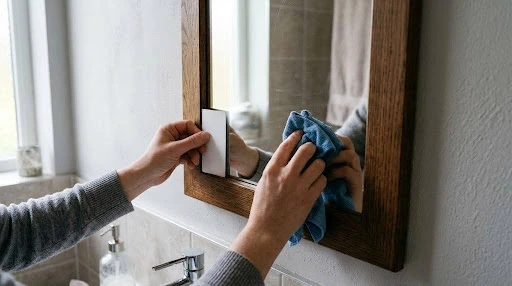
To clean a framed mirror step by step, work in this order: frame first, then glass, then edges, then drying.
- Check the mirror is secure. If it shifts when you touch it, steady it with one hand or ask someone to help. Never press hard on a hanging mirror.
- Dust the frame first. Brush from the top down so loose dust falls away before you clean the glass.
- Dampen the cloth, not the mirror. Use plain water, or one or two light sprays of cleaner onto the cloth. Spraying the glass sends drips straight into the bottom of the frame.
- Clean the glass. Start in the middle and work outwards in straight strokes. Near the frame, hold the card flat against its inner lip so the cloth only touches glass.
- Do the edges by hand. Run a barely damp cotton bud along the last few millimetres of glass, wiping along the frame rather than into the gap.
- Dry straight away. Buff the glass with your dry cloth, then go around the edges once more. Never leave a framed mirror to air-dry.
Working in this order helps you clean the mirror without damaging the frame, because liquid has little chance to reach it. Give the bottom edge an extra dry wipe, since gravity pulls any moisture there.
How should you clean different frame materials?
Clean each frame according to its finish, because a method that’s safe for metal can ruin gold leaf. Before cleaning a decorative frame, test your method on a hidden spot, such as the underside.
| Frame finish | Safe way to clean | What to avoid | Warning signs |
| Sealed or painted timber | Dust, then wipe with a barely damp cloth and dry at once | Soaking, harsh sprays | Swelling, paint lifting at corners |
| Raw or oiled timber | Dry dusting only | Water and sprays, which can stain | Dark water marks, splitting |
| Gilded (gold or metal leaf) | Light, gentle dusting with a soft brush | Any liquid cleaner, rubbing, feather dusters | Flaking or bare patches |
| Metal | Damp cloth with a drop of mild soap, then dry | Scourers, polish not made for that metal | Rust or tarnish near the glass |
| Rattan or cane | Soft brush or a vacuum brush on low | Wetting the weave | Fraying or sagging strands |
Gilded finishes can be highly sensitive to moisture and rubbing. Dust them gently with a soft brush, and get specialist advice before using any liquid. If you can’t tell what kind of gold finish you have, treat it as gilded.
If your frame is timber, our tips on caring for wooden frames cover sunlight, humidity and polishing in more detail. For a sense of how different finishes look once framed, browse examples of finished frames in our gallery.
How can you protect a framed mirror’s edges from moisture?
You protect the edges by keeping liquid off them when you clean and by cutting down the steam they face every day.
Bathrooms are a high-risk spot. Steam settles on the glass, runs down and collects at the bottom of the frame. HealthyWAlists showering without an exhaust fan or open window as a common cause of excess moisture in the home, so run the fan or open a window while you shower.
A few other habits help:
- Wipe sink splashes before they dry.
- Don’t drape damp towels over the frame.
- Keep spray bottles, perfume and hairspray off the frame’s ledge.
Backing plays a part too. Our custom mirror guide explains how protective backing for framed mirrors helps protect the glass against moisture.
Is it dirt or desilvering?
If dark marks along the edge stay the same no matter how gently you clean, you’re looking at desilvering, not dirt. Dirt wipes off the front of the glass, but desilvering happens behind it, where no cloth can reach.
Signs of desilvering include:
- Black or grey spots that start at an edge or corner
- Cloudy patches that seem to sit inside the glass
- Marks that slowly spread over months
Once you spot these, stop scrubbing. Extra rubbing won’t help, and extra liquid near the edge can make things worse.
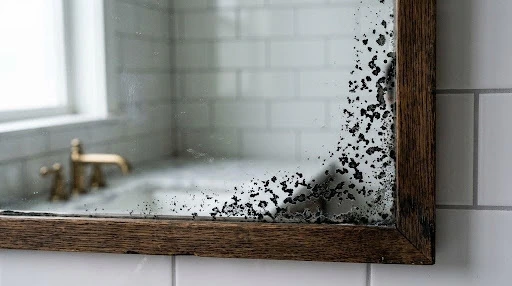
When the damage stays close to the edges, a frame can hide it. The steps are in our guide on how to frame over desilvered edges. A frame covers the marks, but it doesn’t repair or stop the desilvering underneath. If dark patches have spread across the middle of the glass, a frame won’t cover them, and the mirror may need new glass.
When should you seek professional advice for a framed mirror?
Seek professional advice when the problem is with the frame or the backing rather than the glass. Cleaning can’t fix:
- Gold leaf that is flaking, lifting or leaving bare patches
- Glass that rattles or moves inside the frame
- Backing that looks warped, damp or stained
- Corners that have opened up or cracked
- Black edges that keep spreading
If you are unsure about your frame’s finish or notice deterioration, contact Framous Picture Framing to discuss the appropriate next step before attempting further cleaning.
How can you keep a framed mirror in good condition long term?
Check the whole mirror once or twice a year in good light. Regular cleaning keeps the glass clear, but a check catches slow problems with the frame, backing and fixings before they get worse.
What should you look at during a check?
- The glass edges: look for tiny dark dots or a grey haze near the frame.
- The frame corners: check for gaps, cracks or a lifting finish.
- The back: if the mirror is light enough to lift safely, look for warping, damp patches or stains on the backing. Don’t remove the backing board or take the mirror out of its frame to check. Backing construction varies, and mirror glass can be heavy and fragile.
- The hanging hardware: make sure hooks, wire and D-rings are firm and show no rust.
If the fixings look loose or worn, have them checked before the mirror is handled or moved. Our guide to hanging a full-length mirror safely explains wall types, anchors and mounting hardware.
Where should a framed mirror hang?
Where possible, hang a framed mirror away from direct splashes, steam and strong sunlight. Long hours of direct sun can fade and dry out timber frames, while a mirror right beside a shower or kettle faces moisture every day. The best spot depends on the mirror and frame, so ask a framer if you’re unsure.
Framous Picture Framing: Keep your framed mirror looking its best
At Framous Picture Framing, we’ve been framing from the heart of Midland and serving Perth since 1985. Our services cover mirrors, frame renovations and framing accessories, and our team can guide you on frame character, colour and style. If your mirror frame is showing wear or needs replacing, we can help.
Explore Our Mirror Framing and Frame Renovation Services
Prefer to talk first? Call our Midland shop on (08) 9274 1453.
Frequently asked questions
How often should you clean a framed mirror?
Bathroom mirrors may need cleaning weekly if they collect steam, toothpaste or water spots. Mirrors in less-used rooms can often go longer between cleans. Keep dusting of gilded frames light and occasional, and always follow the care instructions for your frame’s finish.
How do you remove sticky residue from mirror glass?
Start by checking the mirror maker’s care instructions. Hold a lightly dampened cloth on the mark for a minute to soften it, then wipe gently. Avoid soaking the area or using solvents near the edges, and seek advice before trying anything stronger.
Can you use furniture polish on a mirror frame?
Only on sealed timber frames. Apply it to a cloth, keep it off the glass, and don’t use it on gilded, painted or rattan frames unless the maker says it’s safe.

Leave a Reply